

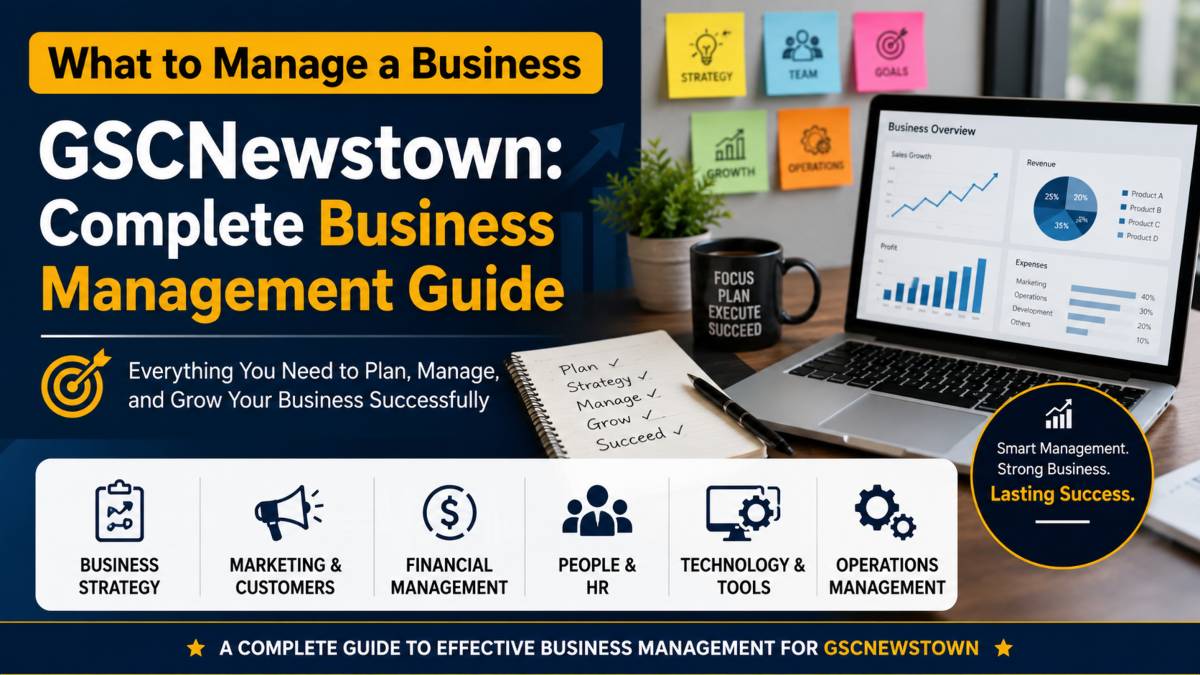
Running a successful business requires much more than offering a product or service. Business owners must oversee several important areas that work together to support growth, customer satisfaction, and financial stability. If you are searching for information about what to manage a business GSCNewstown, understanding these core management responsibilities is the first step toward building a stronger and more organized operation.
Although publicly available information about GSCNewtown is currently limited, the fundamental principles of business management remain the same regardless of location. Every business needs a clear strategy, strong financial control, effective marketing, reliable employees, suitable technology, and efficient daily operations. When these areas receive proper attention, businesses are better prepared to handle challenges, serve customers, and achieve their goals.
This guide explains the key aspects of business management and offers practical insights that can help both new and experienced business owners make informed decisions. By focusing on the right areas, you can create a solid foundation for sustainable growth and improved business performance.
Understanding Business Management Fundamentals
Successful businesses rarely grow by chance. Behind every thriving company is a management approach that keeps operations organized, finances under control, and long term goals in focus. Whether you are launching a new venture or improving an existing one, understanding the fundamentals of business management can help you make smarter choices and create a stronger foundation for growth.
Why Effective Business Management Matters
Effective business management helps bring structure to every aspect of a company. When tasks, goals, and processes are organized, it becomes easier to monitor progress and identify areas that need improvement. Good organization also reduces confusion among team members and helps maintain consistent service for customers.
Another key benefit is improved profitability and sustainability. Business owners who regularly monitor expenses, revenue, and operational performance are better positioned to maintain healthy finances. Careful management can help reduce waste, improve efficiency, and create opportunities for steady growth over time.
Strong management also supports better decision making. Access to accurate information allows business owners to evaluate risks, identify opportunities, and make informed choices. This can lead to more confident planning and stronger business outcomes.
Common Challenges New Business Owners Face
Many new business owners begin with limited resources. Budget constraints, small teams, and restricted access to equipment or technology can make it difficult to compete with established companies. Managing available resources wisely becomes essential during the early stages of growth.
Competition is another common challenge. Businesses often need to work hard to attract customers, build trust, and establish a unique position within their market. Understanding customer needs and delivering consistent value can help create a competitive advantage.
New entrepreneurs must also manage multiple responsibilities at the same time. From marketing and customer service to finance and operations, balancing these tasks can be demanding. Developing strong management skills can make it easier to handle these responsibilities while keeping the business focused on its goals.
Create a Strong Business Strategy
A strong business strategy provides direction and helps business owners make decisions with confidence. Without a clear plan, businesses can lose focus, waste resources, and struggle to achieve meaningful growth. A well structured strategy creates a roadmap that guides daily operations while supporting future expansion. For businesses associated with GSCNewstown or any other location, developing a solid strategy is one of the most important steps toward long term success.
Develop a Business Plan
A business plan serves as the foundation of your strategy. It outlines your objectives, identifies your target market, and explains how your business intends to generate revenue. A clear plan helps you stay focused on priorities and measure progress over time.
Setting realistic goals is an essential part of business planning. These goals should provide direction and help track performance. Whether the objective is increasing sales, expanding services, or improving customer retention, clearly defined goals make it easier to evaluate success.
Market positioning is another important element. Understanding where your business fits within the market helps you identify your unique value. By studying customer needs and competitor offerings, you can determine what makes your products or services attractive to potential customers.
Revenue expectations should also be included in the business plan. Estimating income, expenses, and growth potential allows business owners to make informed financial decisions and prepare for future opportunities or challenges.
Define Your Vision and Mission
A vision statement describes what your business hopes to achieve in the future. It provides inspiration and gives employees and stakeholders a clear picture of the company’s long term aspirations. A strong vision helps maintain focus even as the business evolves.
A mission statement explains the purpose of the business and the value it provides to customers. It answers key questions about what the company does and why it exists. Together, the vision and mission create a sense of direction that supports decision making and business growth.
Conduct a SWOT Analysis
A SWOT analysis is a practical tool that helps business owners evaluate their current position. It examines four key areas that influence performance and future planning.
Strengths represent the internal advantages that help a business succeed. These may include industry expertise, strong customer relationships, or high quality products and services.
Weaknesses are areas that may limit growth or performance. Identifying these challenges allows businesses to develop plans for improvement.
Opportunities refer to external factors that can support growth. These might include changing market trends, new customer demands, or expansion possibilities.
Threats are external risks that could affect business performance. Examples include increased competition, economic uncertainty, or shifts in consumer behavior. Understanding these risks helps businesses prepare and respond more effectively.
By combining a detailed business plan with a clear vision, mission, and SWOT analysis, business owners can build a strategy that supports sustainable growth and informed decision making.
Manage Marketing and Customer Acquisition
Marketing plays a central role in business growth because it helps attract potential customers and build lasting relationships with existing ones. Even businesses with excellent products or services can struggle if people are unaware of what they offer. A well planned marketing approach helps increase visibility, strengthen brand recognition, and create more opportunities for sales. For businesses connected to GSCNewstown or any other market, understanding customers and promoting your business consistently can support steady growth.
Understand Customer Needs
Successful marketing begins with understanding the people you want to serve. Audience research helps business owners learn about customer preferences, purchasing habits, and expectations. This information can be collected through surveys, customer feedback, online reviews, and market research.
Knowing your target audience allows you to create products, services, and marketing messages that match their interests. Rather than trying to appeal to everyone, businesses can focus their efforts on the customers most likely to make a purchase.
Identifying customer pain points is equally important. Pain points are the challenges, frustrations, or problems customers want to solve. When businesses understand these concerns, they can position their offerings as valuable solutions. Addressing customer needs directly often leads to stronger engagement and increased trust.
Build a Marketing Strategy
A marketing strategy provides a structured plan for reaching potential customers and encouraging them to take action. One of the most useful approaches is content marketing. Creating helpful articles, guides, videos, and other informative content can attract visitors while building credibility within your industry.
Social media is another valuable marketing channel. Platforms such as Facebook, Instagram, LinkedIn, and TikTok allow businesses to connect with audiences, share updates, and interact with customers in real time. Consistent posting and meaningful engagement can help strengthen brand awareness and customer loyalty.
Local promotion can also support business growth, especially for companies serving specific communities. Participating in local events, building partnerships with nearby businesses, and maintaining accurate business listings can increase visibility among local customers.
Monitor Competitor Activity
Understanding competitor activity can help businesses identify opportunities and improve their marketing efforts. Observing how competitors communicate with customers, promote products, and position their brands can reveal useful insights.
Keeping track of market trends is also important. Customer preferences, industry developments, and emerging technologies can influence buying behavior. Businesses that stay informed are often better prepared to adapt and remain relevant.
Competitive positioning involves defining what makes your business different from others in the market. Whether it is superior service, specialized expertise, better pricing, or unique products, clearly communicating these advantages can help attract customers and strengthen your market presence.
By understanding customer needs, implementing a focused marketing strategy, and monitoring industry competition, businesses can attract more customers and create a stronger foundation for long term success.
Control Business Finances
Financial management is one of the most important responsibilities of any business owner. Strong financial control helps maintain stability, supports informed decision making, and prepares a business for future growth. Even businesses with strong sales can encounter difficulties if finances are not monitored carefully. By tracking cash flow, creating realistic budgets, and forecasting future performance, business owners can build a stronger financial foundation and reduce uncertainty.
Track Cash Flow
Cash flow refers to the movement of money into and out of a business. Monitoring cash flow regularly helps business owners understand their financial position and avoid unexpected shortages. A business may generate revenue, but if payments are delayed while expenses continue to accumulate, financial pressure can quickly develop.
Income monitoring is a key part of cash flow management. Business owners should keep accurate records of sales, customer payments, and other revenue sources. Regular reviews help identify trends and reveal whether income is meeting expectations.
Expense management is equally important. Tracking operational costs, supplier payments, employee wages, and other expenditures helps maintain financial control. Reviewing expenses regularly can uncover unnecessary spending and create opportunities to improve profitability. Maintaining a healthy balance between income and expenses supports smoother daily operations and stronger financial stability.
Create Realistic Budgets
A budget serves as a financial roadmap that helps businesses allocate resources wisely. Without a clear budget, spending can become difficult to manage, leading to unnecessary financial strain. A realistic budget provides structure and helps business owners make better financial decisions throughout the year.
Monthly planning is an important part of budgeting. Business owners should estimate expected income and expenses while accounting for recurring costs such as rent, utilities, payroll, and marketing activities. Regular budget reviews help ensure that spending remains aligned with business goals.
Cost control is another essential element of financial management. Businesses that monitor expenses closely can identify areas where resources are being used inefficiently. Reducing unnecessary costs does not always require major changes. Small adjustments in purchasing decisions, operational processes, or resource allocation can improve overall financial performance.
Forecast Revenue and Growth
Revenue forecasting helps businesses prepare for future opportunities and challenges. By analyzing historical performance, market conditions, and sales trends, business owners can develop realistic expectations for future income. Financial projections provide valuable guidance when planning investments, hiring employees, or expanding operations.
Accurate forecasting also supports better risk management. Every business faces uncertainties, including economic changes, shifts in customer demand, and increased competition. Identifying potential risks early allows business owners to develop contingency plans and respond more effectively when challenges arise.
Strong financial management is not only about tracking numbers. It is about understanding how financial decisions influence every aspect of the business. By monitoring cash flow, maintaining realistic budgets, and forecasting future performance, businesses can improve stability, support growth, and create a stronger path toward long term success.
Manage Employees and Human Resources
Employees play a vital role in the success of any business. No matter how strong a company’s products, services, or marketing efforts may be, long term growth often depends on the people responsible for carrying out daily operations. Effective human resource management helps businesses attract talented individuals, improve productivity, and create a work environment where employees can perform at their best. By focusing on hiring, performance development, and workplace culture, business owners can build a stronger and more reliable team.
Hire the Right People
Recruiting the right employees is one of the most important business decisions. Hiring individuals who possess the necessary skills and experience can improve efficiency and reduce costly mistakes. Before filling a position, business owners should clearly define the responsibilities and qualifications required for the role.
Skill assessment helps identify candidates who can perform the job effectively. Reviewing experience, conducting interviews, and evaluating practical abilities can provide valuable insight into a candidate’s suitability.
Role alignment is equally important. Even highly qualified individuals may struggle if their strengths do not match the demands of the position. Placing employees in roles that fit their skills and interests often leads to better performance, greater job satisfaction, and improved retention.
Improve Employee Performance
Employee development should continue after the hiring process. Ongoing training helps team members build new skills, adapt to changing business needs, and stay informed about industry developments. Businesses that invest in employee growth often benefit from improved productivity and stronger overall performance.
Training can take many forms, including workshops, online courses, mentoring programs, and hands on learning experiences. Providing employees with opportunities to develop professionally can increase confidence and contribute to higher quality work.
Feedback systems are another important component of performance management. Regular feedback helps employees understand their strengths and identify areas for improvement. Constructive discussions about performance can encourage growth, improve accountability, and support professional development.
Build a Positive Workplace Culture
A positive workplace culture can have a significant influence on employee satisfaction and business success. Employees are more likely to remain engaged and motivated when they feel respected, valued, and supported.
Effective communication is a key part of a healthy work environment. Clear communication helps prevent misunderstandings, improves efficiency, and ensures that employees understand expectations and business goals.
Team collaboration also contributes to a stronger workplace culture. Encouraging employees to share ideas, solve problems together, and support one another can improve productivity and strengthen relationships within the organization. When businesses create a culture built on trust, communication, and teamwork, employees are often more committed to helping the company achieve its objectives.
Invest in Technology and Business Tools
Technology has become an essential part of modern business management. The right tools can improve communication, simplify daily operations, enhance customer relationships, and support better decision making. Businesses that invest in suitable technology often experience greater efficiency and improved productivity. However, selecting the right solutions requires careful planning to ensure that investments deliver real value. By focusing on essential technology, evaluating costs carefully, and using automation where appropriate, businesses can strengthen their operations and support future growth.
Choose Essential Business Technology
Every business relies on tools that help teams communicate and collaborate effectively. Communication platforms make it easier for employees to share information, coordinate projects, and stay connected, whether they work in the same location or remotely. Clear communication supports smoother operations and reduces misunderstandings.
Accounting software is another valuable investment. These systems help track income, expenses, invoices, and financial reports with greater accuracy. Automated financial records can save time while providing business owners with a clearer view of their financial health.
Customer relationship management systems, often called CRM systems, help businesses organize customer information, track interactions, and manage sales opportunities. A well maintained CRM system can improve customer service, strengthen relationships, and support business growth by helping teams stay focused on customer needs.
Balance Technology Costs and Benefits
Investing in technology should always involve careful evaluation. While advanced tools may offer useful features, not every solution is necessary for every business. Before making a purchase, business owners should assess how the technology will contribute to operational improvements and financial performance.
Evaluating return on investment helps determine whether a technology solution is worth the expense. Business owners should consider factors such as time savings, increased productivity, improved customer satisfaction, and potential revenue growth when making decisions.
Budget friendly solutions can often provide excellent value without placing unnecessary strain on financial resources. Many software providers offer scalable options that allow businesses to start with essential features and expand as their needs grow.
Improve Productivity Through Automation
Automation can help businesses complete routine tasks more efficiently while reducing manual effort. By automating repetitive processes, employees can focus more attention on activities that contribute directly to growth and customer satisfaction.
Workflow optimization is one of the primary benefits of automation. Automated systems can handle tasks such as scheduling, invoicing, data entry, and customer follow ups, helping reduce delays and improve consistency.
Time saving tools also contribute to higher productivity. Project management platforms, automated reporting systems, and digital collaboration tools can help teams work more efficiently while maintaining accuracy. When used strategically, automation allows businesses to improve performance, reduce operational burdens, and create a more productive working environment.
Optimize Daily Operations
Efficient daily operations are essential for maintaining productivity, controlling costs, and delivering a consistent customer experience. No matter the size of a business, operational efficiency influences profitability and overall performance. When processes are organized and monitored regularly, businesses can reduce errors, improve teamwork, and respond more effectively to changing demands. By streamlining workflows, tracking performance, and focusing on customer service, business owners can create a stronger and more efficient operation.
Streamline Business Processes
Business processes should be designed to support efficiency and consistency. When workflows are unclear or overly complicated, employees may waste valuable time completing routine tasks. Streamlining processes helps eliminate unnecessary steps and allows work to move more smoothly from one stage to the next.
Workflow management plays an important role in operational success. Business owners should evaluate how tasks are assigned, completed, and reviewed. Identifying bottlenecks and inefficiencies can help improve productivity and reduce delays. Clear workflows also make it easier for employees to understand their responsibilities and contribute more effectively.
Process documentation is another valuable practice. Documenting procedures creates a reference that employees can follow when performing tasks. This helps maintain consistency, reduces confusion, and supports training efforts. Well documented processes can also make it easier to scale operations as the business grows.
Monitor Performance Metrics
Measuring performance allows businesses to understand what is working and where improvements may be needed. Without accurate data, it can be difficult to assess progress or make informed decisions.
Key performance indicators, commonly known as KPIs, provide measurable benchmarks for evaluating business activities. Depending on the nature of the business, KPIs may include sales growth, customer retention, operational efficiency, profit margins, or employee productivity. Tracking these indicators regularly helps identify strengths and areas requiring attention.
Business reporting provides a structured way to review performance data. Regular reports allow business owners and managers to monitor trends, evaluate results, and make adjustments when necessary. Consistent reporting supports accountability and helps ensure that business objectives remain on track.
Improve Customer Service
Customer service has a direct influence on business reputation and customer loyalty. Businesses that provide a positive customer experience are more likely to retain customers and generate repeat business.
Response times are a critical component of customer service. Customers appreciate timely answers to questions, concerns, and support requests. Faster response times can improve satisfaction and demonstrate a commitment to customer care.
Customer satisfaction should be monitored continuously through feedback, surveys, and reviews. Understanding customer opinions helps businesses identify opportunities for improvement and strengthen relationships with their audience. By listening to customers and acting on feedback, businesses can create experiences that encourage loyalty and long term success.
When business processes are streamlined, performance is measured consistently, and customer service remains a priority, daily operations become more efficient and better equipped to support sustainable growth.
Tips for Long Term Business Growth
Building a successful business is not only about achieving short term results. Sustainable growth requires consistent effort, strategic planning, and the ability to respond to changing market conditions. Businesses that remain flexible and focused on improvement are often better prepared to overcome challenges and capture new opportunities. By adapting to market changes, increasing revenue sources, and regularly reviewing business goals, owners can create a stronger foundation for continued success.
Adapt to Market Changes
Markets are constantly changing due to economic conditions, technological developments, customer preferences, and industry innovations. Businesses that monitor these changes closely are more likely to remain competitive and relevant.
Keeping up with industry trends can help identify new opportunities and potential risks. Business owners should stay informed about developments within their sector through industry publications, professional networks, customer feedback, and market research. Understanding these trends allows businesses to make informed decisions and adjust their strategies when necessary.
Customer behavior can also change over time. Purchasing habits, expectations, and preferences often evolve as new products, technologies, and services become available. Businesses that pay attention to these shifts can better meet customer needs and maintain strong relationships with their audience.
Expand Revenue Opportunities
One way to support long term growth is by creating additional sources of income. Relying on a single product or service can limit growth potential and increase vulnerability during market changes.
Introducing new products can help attract different customer segments and encourage existing customers to make additional purchases. Before launching a new offering, businesses should evaluate market demand and ensure that the product aligns with customer needs.
Providing additional services is another effective way to increase revenue. Businesses can often build on their existing expertise by offering complementary services that enhance customer value. This approach can strengthen customer relationships while creating new opportunities for income generation.
Review and Update Business Goals
Business goals should not remain unchanged for years. Regular reviews help ensure that objectives remain relevant and aligned with current market conditions and business performance.
Quarterly reviews provide an opportunity to assess progress, evaluate challenges, and identify areas for improvement. These reviews can help business owners determine whether existing strategies are producing the desired results.
Performance tracking is equally important. Monitoring key metrics allows businesses to measure success and make data driven decisions. Reviewing performance regularly helps identify trends, uncover growth opportunities, and maintain accountability throughout the organization.
Long term business growth requires adaptability, innovation, and consistent evaluation. Businesses that stay aware of market changes, pursue new revenue opportunities, and review their goals regularly are better positioned to achieve lasting success and remain competitive in an evolving marketplace.
Conclusion
Successfully managing a business requires attention to several interconnected areas that work together to support growth and stability. Throughout this guide, we have covered six essential aspects of business management: business strategy, marketing and customer acquisition, financial management, human resources, technology and business tools, and daily operations. Each area contributes to the overall performance of a business and plays a role in achieving long term goals.
Strong planning helps provide direction and clarity, while effective marketing attracts and retains customers. Careful financial management supports stability and informed decision making. Managing employees properly helps build a productive and motivated workforce, while the right technology can improve efficiency and simplify daily tasks. Well organized operations ensure that business activities run smoothly and consistently.
Business management is an ongoing process rather than a one time effort. Markets change, customer expectations evolve, and new opportunities emerge over time. Business owners who regularly review their strategies, monitor performance, and look for ways to improve are often better positioned for sustainable growth. By focusing on continuous improvement across all key management areas, businesses can build a stronger foundation for future success and remain competitive in a changing marketplace.
Read More: https://getmailzeno.com/what-is-social-media-stuff-embedtree/