

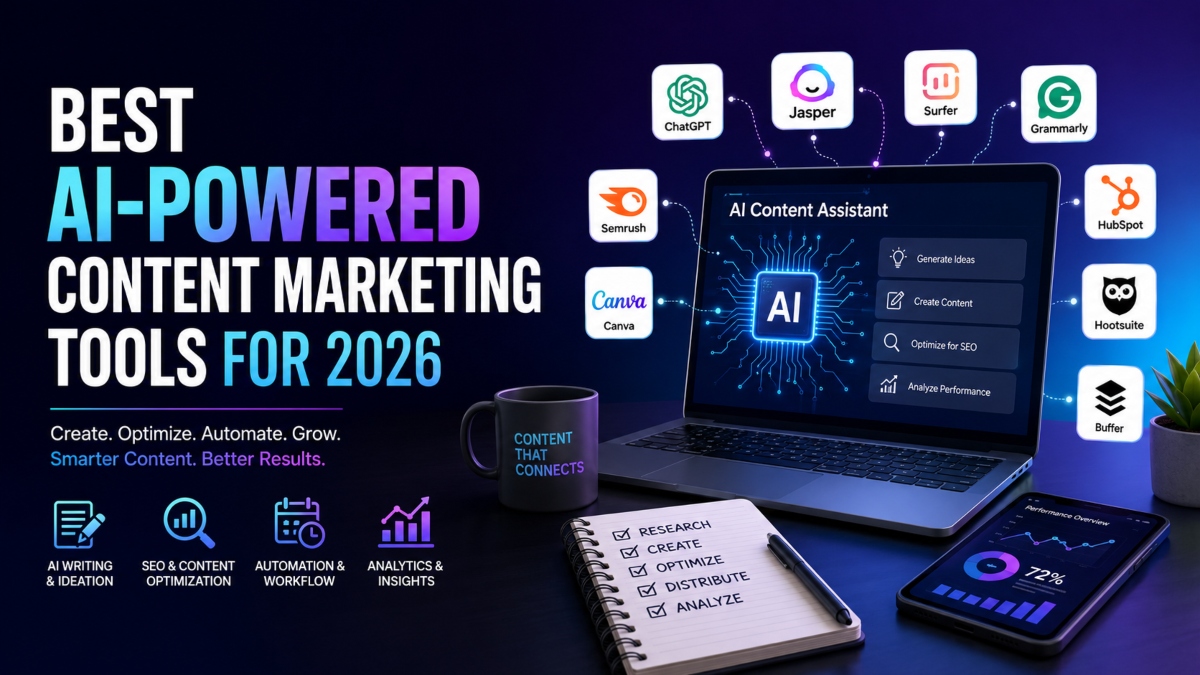
Content marketing has entered a new phase where speed, consistency, and scale matter more than ever. Brands are expected to publish blogs, emails, social posts, videos, and SEO content across multiple platforms without slowing down. That growing pressure is exactly why the best AI powered content marketing tools for 2026 are becoming essential for businesses, creators, and marketing teams trying to stay competitive.
Modern AI content marketing tools are no longer limited to basic text generation. They now help marketers research keywords, create outlines, optimize SEO, design visuals, repurpose blog posts, automate publishing, and analyze performance data from a single workflow. Instead of spending hours on repetitive production tasks, teams can focus more attention on strategy, creativity, and audience engagement.
The rise of AI tools for marketers also reflects how quickly digital content cycles move today. Search trends shift faster, audience attention changes constantly, and brands need to respond with fresh content at a much higher pace. AI powered platforms help reduce production bottlenecks while improving workflow efficiency across writing, editing, design, social media, and analytics.
Still, the strongest results come from combining automation with human creativity. AI can speed up research and production, but strong storytelling, original thinking, and brand voice still depend on skilled marketers who know how to shape content people actually want to read.
Why AI Tools Are Changing Content Marketing
Content marketing has become faster, more crowded, and far more demanding than it was only a few years ago. Brands are expected to publish blogs, newsletters, videos, social posts, and SEO content consistently while keeping quality high across every channel. That pressure has pushed businesses toward AI content generation tools that can help teams produce more content without slowing down production.
The shift is not only about speed. Marketers also need stronger personalization, faster research, and better performance tracking to compete in crowded digital spaces. This is where AI powered platforms are reshaping modern marketing operations.
Growing Demand for Faster Content Production
Most businesses now publish across several platforms at the same time. A single campaign may require blog content, email sequences, short videos, LinkedIn posts, Instagram captions, and search optimized landing pages within a tight deadline.
That constant multi platform publishing pressure creates heavy production demands for marketing teams. Audiences also expect fresh content regularly, which increases the need for faster workflows and consistent publishing schedules.
Content volume expectations continue rising because brands compete for visibility every day. Companies that publish useful and timely content more consistently often gain stronger search visibility and audience attention compared to slower competitors.
How AI Improves Marketing Workflows
AI marketing workflow systems help reduce repetitive manual tasks that normally consume large amounts of time. Writers can generate outlines, topic ideas, and draft structures within minutes instead of starting from scratch for every project.
Content automation software also supports keyword research, SEO recommendations, grammar correction, social media scheduling, and content repurposing. A long blog post can quickly become email copy, video scripts, social captions, and short form content for multiple platforms.
This level of automation allows marketers to spend more time refining strategy and improving campaign quality instead of handling repetitive production work manually.
Human Creativity Still Matters
Even with stronger AI content generation capabilities, human creativity remains essential. AI tools can produce drafts and suggestions quickly, but they still rely on human direction for originality, emotional tone, and strategic messaging.
Brand voice is another area where human input matters heavily. Without editing and refinement, AI generated content can sound repetitive or generic.
Fact checking also remains critical because automated systems can occasionally produce inaccurate or outdated information. Strong marketers use AI as a support tool rather than a replacement for creative thinking, editing judgment, and content strategy.
Best AI Writing and Ideation Tools
Writing content at scale has become one of the biggest challenges for modern marketing teams. Brands need blog posts, landing pages, email campaigns, product descriptions, social captions, and SEO content published constantly to stay visible online. This growing demand has pushed AI writing tools from optional software into everyday marketing essentials.
The strongest platforms now do much more than generate text. They help with brainstorming, outlining, editing, workflow management, and content expansion across multiple channels. Different tools also serve different needs, which is why marketers often combine several platforms into one production system.
ChatGPT for Brainstorming and Long Form Content
ChatGPT has become one of the most widely used AI blog writing tools because of its flexibility and conversational workflow. Marketers use it for topic ideation, keyword clustering, article outlines, email drafting, FAQ generation, and long form content creation.
One of its biggest strengths is speed during the planning stage. Instead of staring at a blank page, writers can generate multiple headline ideas, article structures, and campaign angles within minutes. This helps reduce creative slowdown and speeds up production cycles significantly.
ChatGPT is also useful for research assistance. It can summarize topics, organize information into readable sections, and help marketers simplify complex ideas into audience friendly language. Many teams use it as an early stage drafting assistant before refining content manually.
Long form drafting is another area where the platform performs well. Blog introductions, section expansions, product comparisons, and SEO focused outlines can all be produced quickly with the right prompts. Still, human editing remains essential to maintain originality, brand personality, and factual accuracy.
Jasper for Marketing Teams and Brand Voice
Jasper is designed more directly for marketing operations and collaborative content production. Unlike general purpose chat platforms, Jasper focuses heavily on campaign workflows, brand consistency, and reusable marketing templates.
Marketing teams often use Jasper for blog posts, ad copy, email sequences, product campaigns, and branded messaging across different channels. The platform supports tone customization, allowing businesses to maintain a more recognizable writing style across large content libraries.
Templates also help speed up repetitive tasks. Teams can create standardized workflows for product launches, paid ads, social campaigns, and SEO content production without rebuilding structures each time.
Collaboration features make Jasper especially useful for agencies and larger businesses managing multiple writers or approval systems. Instead of scattered documents and disconnected workflows, teams can organize production more centrally.
Copy.ai and Writesonic for Fast Copy Creation
Copy.ai and Writesonic are popular AI copywriting software options built for speed and short form marketing content. These platforms are often used for quick production tasks where efficiency matters more than long form depth.
Product descriptions are one of the most common use cases. E commerce brands can generate multiple variations quickly while adjusting tone, formatting, and promotional messaging.
Social captions are another strong area for both tools. Marketers can create platform specific captions, ad variations, promotional hooks, and call to action copy within minutes.
Landing page creation also becomes faster with AI support. Headlines, feature sections, sales messaging, and conversion focused copy can be drafted rapidly, helping businesses test campaigns more efficiently without slowing production timelines.
Best AI SEO and Content Optimization Tools
Creating content is only part of the challenge. Without strong search visibility, even well written articles can struggle to attract traffic. This is why AI SEO tools have become essential for marketers who want stronger rankings, better keyword targeting, and more consistent organic growth.
Modern optimization platforms now combine keyword research, competitor analysis, SERP monitoring, and content scoring into one workflow. Instead of relying on guesswork, marketers can use data driven recommendations to build content that matches what users and search engines actually want.
The best AI content optimization tools also help reduce wasted effort by identifying ranking opportunities before content is published.
Semrush for Keyword Research and Content Briefs
Semrush remains one of the strongest all in one platforms for SEO research and planning. Many marketers use it to discover keyword opportunities, analyze competitors, and create search focused content strategies before writing even begins.
Topic research features help identify trending questions, related search phrases, and high interest themes connected to a target keyword. This makes it easier to build articles around real search demand instead of assumptions.
Content gap analysis is another major advantage. Marketers can compare their website against competitors to identify keywords and topics they are missing. This process helps uncover ranking opportunities that competitors already capture successfully.
SERP tracking tools also allow businesses to monitor how pages perform over time. Rankings, keyword movement, and competitor visibility can all be tracked in one dashboard, giving marketers a clearer view of what content strategies produce results.
For many teams, Semrush functions as both a research engine and a strategic planning platform for AI powered SEO optimization.
Surfer SEO for On Page Optimization
Surfer SEO focuses heavily on improving content structure and on page optimization. Instead of simply generating keywords, the platform analyzes top ranking pages and compares your draft against current search results.
One of its most recognized features is content scoring. As marketers write, Surfer provides a live score based on keyword usage, structure, headings, readability, and topical relevance. This helps writers optimize content while drafting instead of revising everything afterward.
Keyword placement suggestions also improve search relevance. The platform recommends related terms and topic coverage based on what already ranks highly in search engines.
Structure suggestions make the writing process more organized as well. Recommended headings, paragraph length guidance, and topic coverage insights help marketers create content that matches current ranking patterns more closely.
Many businesses combine Surfer with AI writing platforms to speed up production while maintaining stronger SEO performance.
Ahrefs for Competitor and Search Analysis
Ahrefs is widely used for competitor research, backlink analysis, and identifying high value keyword opportunities. Its data helps marketers understand why certain pages rank well and where traffic potential exists inside specific niches.
Backlink analysis is one of the platform’s strongest features. Marketers can examine which websites link to competitors and identify opportunities to strengthen their own authority through outreach and content partnerships.
Traffic potential metrics also help prioritize topics with stronger ranking opportunities instead of chasing low value keywords with minimal search demand.
Keyword research tools inside Ahrefs reveal search volume, ranking difficulty, click potential, and related keyword variations. This allows marketers to build content strategies around realistic opportunities instead of highly competitive terms that are difficult to rank for.
Together, Semrush, Surfer SEO, and Ahrefs form a strong foundation for businesses focused on search visibility, content performance, and long term organic traffic growth.
Best AI Editing and Readability Tools
Writing fast is valuable, but publishing clean and readable content matters even more. Many AI generated drafts still need refinement before they are ready for search engines or real audiences. Grammar issues, awkward phrasing, inconsistent tone, and overly complex sentences can weaken content quality quickly. This is why AI editing tools have become a critical part of modern content workflows.
Editing platforms help marketers polish drafts, improve readability, and create a smoother reading experience across blogs, emails, landing pages, and social content. They also help teams maintain consistent writing standards when multiple people contribute to the same projects.
Grammarly for Tone and Clarity Improvements
Grammarly remains one of the most widely used content quality tools because it combines grammar correction with tone analysis and writing suggestions inside a simple interface.
Grammar checks help catch spelling errors, punctuation problems, missing words, and sentence structure issues before content goes live. This improves professionalism and reduces avoidable mistakes that can hurt credibility.
Tone adjustments are another valuable feature for marketing teams. Writers can shape content to sound more professional, conversational, confident, or audience focused depending on the campaign goal.
Rewrite suggestions also help simplify awkward phrasing and improve clarity. Instead of manually restructuring difficult sentences, writers receive instant alternatives that make content easier to read and more natural sounding.
For teams producing large amounts of content, Grammarly often works as a final quality control layer before publication.
Hemingway and ProWritingAid for Readability
Hemingway and ProWritingAid focus more heavily on readability and writing flow. These readability tools help writers simplify dense content and create cleaner sentence structures that are easier for audiences to process quickly.
Hemingway highlights long sentences, passive voice, unnecessary complexity, and difficult phrasing. This encourages shorter and more direct writing that improves user experience, especially for online readers who scan content rapidly.
Readability scoring also helps marketers measure how accessible their content feels for different audiences. Simpler writing often performs better because readers can absorb information faster without losing attention.
ProWritingAid adds deeper style analysis by checking consistency, repetition, pacing, and sentence variation across larger pieces of content. This helps maintain a smoother rhythm throughout blog posts and long form articles.
Together, these AI editing tools strengthen clarity, improve readability, and help marketers publish content that feels cleaner, sharper, and easier to engage with.
Best AI Design and Video Creation Tools
Visual content has become one of the biggest drivers of online engagement. Blog posts alone are no longer enough for brands trying to capture attention across social media, search results, video platforms, and email campaigns. Modern audiences expect graphics, short videos, animations, and branded visuals alongside written content. This shift has pushed AI design tools and AI video creation tools into the center of modern marketing workflows.
These platforms help marketers create visual assets faster while reducing the need for large production teams or advanced editing skills. Instead of building every asset manually, businesses can now turn ideas, articles, and campaigns into polished visuals within minutes.
Canva for Social Graphics and Visual Content
Canva remains one of the most widely used AI design tools because it combines simplicity with strong creative flexibility. Marketers use it for social graphics, blog banners, presentations, ad creatives, infographics, and branded marketing visuals without needing professional design experience.
Magic Write adds AI powered writing support directly inside the platform, helping users generate captions, headlines, descriptions, and creative text while designing visuals. This speeds up content production by keeping writing and design inside the same workflow.
Templates are another major advantage. Businesses can quickly customize prebuilt layouts for Instagram posts, YouTube thumbnails, LinkedIn graphics, and promotional materials while maintaining visual consistency across campaigns.
AI image support also helps marketers generate or edit visuals faster. Background removal, image resizing, visual enhancement, and AI assisted graphics allow teams to produce polished creative assets without relying heavily on external design software.
Lumen5 and Pictory for Video Repurposing
Video content continues to dominate engagement across digital platforms, but producing videos manually often requires time, editing skills, and production resources. Lumen5 and Pictory simplify this process by turning written content into short videos automatically.
One of the strongest use cases is blog to video conversion. Marketers can upload articles or scripts and quickly transform them into visual stories with scenes, transitions, captions, and music.
Captions and short form clips are especially valuable for platforms where silent viewing is common. These tools automatically generate subtitles and shorter video snippets that fit social media formats more naturally.
For brands producing long form content regularly, repurposing articles into videos helps extend reach without rebuilding campaigns from scratch.
Freepik AI Suite for Creative Asset Generation
Freepik AI Suite expands visual content marketing beyond static graphics by offering AI generated images, video elements, audio tools, and creative editing features inside one platform.
Marketers can create custom visuals for blog posts, ads, social campaigns, and presentations much faster compared to traditional design workflows. AI images are particularly useful for brands that need unique visuals without relying entirely on stock photography.
Audio and video tools also support content production for podcasts, short videos, and promotional campaigns. This allows businesses to create more varied marketing assets while reducing production bottlenecks.
Together, these AI design tools help marketers produce stronger visual campaigns faster while keeping content production more scalable across multiple channels.
Best AI Social Media and Distribution Tools
Creating content is only half the battle. Distribution is what determines whether content actually reaches an audience or disappears unnoticed. Modern brands publish across multiple social platforms daily, which makes scheduling, repurposing, and audience timing increasingly difficult to manage manually. This is where AI tools for social media marketing help simplify workflows and maintain consistent publishing without overwhelming marketing teams.
Strong distribution tools do more than queue posts. They help marketers identify better posting times, automate repetitive tasks, adapt content for different platforms, and maintain brand consistency across large publishing schedules.
Hootsuite and Buffer for Scheduling and Automation
Hootsuite and Buffer remain two of the most popular social media scheduling tools because they combine automation with easy content management across multiple channels.
One major advantage is best posting time analysis. Instead of publishing randomly, marketers can schedule content during periods when audiences are more active and likely to engage. This helps improve visibility and interaction without increasing content volume.
Social automation also reduces repetitive publishing tasks. Blog posts, videos, product launches, and promotional updates can be scheduled weeks in advance, allowing teams to maintain consistency even during busy production cycles.
Multi platform publishing is another key benefit. Rather than uploading content separately to Instagram, LinkedIn, Facebook, X, and other platforms, marketers can manage distribution from one dashboard. This creates a more organized workflow while saving time across larger campaigns.
Buffer is often preferred for simplicity and clean scheduling workflows, while Hootsuite offers deeper analytics and broader team management features for larger organizations.
OwlyGPT for AI Assisted Social Content
OwlyGPT introduces AI support directly into the social publishing process by helping marketers generate posts, captions, and content ideas faster.
Post generation tools assist teams when they need quick variations for promotions, announcements, or campaign launches. Instead of manually rewriting the same message for every platform, marketers can create multiple versions tailored to different audiences.
Caption support is especially useful for short form content where speed and consistency matter. AI suggestions help improve readability, calls to action, and engagement focused messaging without slowing production.
Brand voice consistency also becomes easier to maintain when teams produce large amounts of content across several channels. AI assistance can help preserve tone and style across campaigns while reducing repetitive editing work.
Combined together, these AI content distribution platforms help businesses publish faster, stay organized, and keep content flowing consistently across multiple social channels.
Best AI Email Marketing and Personalization Platforms
Email marketing remains one of the highest converting digital channels, but audience expectations have changed dramatically. Generic mass emails no longer perform the way they once did because users expect more relevant messaging, better timing, and personalized experiences. This shift has pushed AI email marketing software into a major role within modern marketing strategies.
AI powered platforms now help businesses automate campaigns, personalize customer journeys, improve open rates, and predict user behavior with far greater accuracy. Instead of sending identical emails to entire subscriber lists, marketers can build smarter campaigns tailored to specific audience actions and interests.
HubSpot for CRM and AI Marketing Automation
HubSpot combines customer relationship management with AI marketing automation tools that support personalization, lead management, and campaign optimization inside one system.
One of its strongest advantages is customer segmentation. Businesses can group users based on demographics, purchase history, engagement behavior, or website activity. This allows marketers to send more targeted emails instead of broad messages that feel irrelevant to subscribers.
Personalization features also improve engagement by tailoring subject lines, email content, recommendations, and follow up sequences to individual users. Emails feel more relevant because messaging adapts to customer behavior instead of relying on static campaigns.
Predictive analytics adds another layer of intelligence by helping marketers identify which leads are more likely to convert or engage. This allows businesses to focus campaigns more strategically while improving conversion efficiency across larger email lists.
HubSpot works particularly well for companies managing large customer databases, long sales cycles, or multi channel marketing operations.
ActiveCampaign and Mailmodo for Smarter Campaigns
ActiveCampaign and Mailmodo focus heavily on automation, engagement, and behavior based targeting. These platforms help businesses create more responsive email campaigns without requiring constant manual management.
Subject line optimization is one of the most valuable AI driven features because even small improvements in open rates can influence overall campaign performance significantly. AI systems analyze patterns and recommend stronger subject lines based on engagement data.
Behavioral targeting also improves campaign relevance. Emails can trigger automatically based on customer actions such as abandoned carts, website visits, previous purchases, or email interactions. This creates more timely communication that feels connected to actual user behavior.
Automated workflows help businesses manage onboarding sequences, promotional campaigns, customer retention emails, and follow up messages at scale. Instead of building every campaign manually, marketers can create systems that run continuously in the background.
Together, these personalized marketing tools help businesses improve engagement, increase conversions, and create stronger customer relationships through more intelligent email communication.
Best AI Analytics and Content Intelligence Tools
Publishing content without analyzing performance is like running marketing campaigns blindfolded. Traffic numbers alone no longer tell the full story because marketers need deeper insight into audience behavior, engagement trends, and content effectiveness across multiple platforms. This is where AI driven analytics and content intelligence tools become valuable for modern marketing teams.
These platforms help businesses understand what audiences care about, which content generates engagement, and where growth opportunities exist. Instead of relying on guesswork, marketers can make decisions based on measurable performance data and audience behavior patterns.
GWI Spark for Audience Insights
GWI Spark focuses heavily on audience research and consumer behavior analysis. Marketers use it to understand how different audience groups interact with brands, content, and digital platforms.
Consumer behavior insights help businesses identify interests, buying habits, media preferences, and online activity trends connected to specific demographics. This makes campaigns more targeted and audience focused.
Market research capabilities also support content planning by revealing what topics and formats resonate most with particular customer groups. Instead of producing content based only on assumptions, marketers can build strategies around real audience data.
Audience segmentation features allow teams to divide users into more specific groups based on interests, lifestyle patterns, purchasing habits, or digital behavior. This creates stronger personalization opportunities across campaigns and content strategies.
Semrush Analytics for Content Performance Tracking
Semrush extends beyond SEO research by offering detailed content performance tracking and competitor analysis tools.
Traffic analysis features help marketers understand which pages attract the most visitors, where traffic originates, and how users move through a website. This makes it easier to identify strong performing content as well as weaker pages that need improvement.
Engagement tracking provides visibility into metrics such as bounce rates, session duration, clicks, and interaction patterns. These insights help marketers understand whether audiences actually connect with the content after arriving on the page.
Competitor monitoring is another major advantage. Businesses can track keyword movement, content performance, and visibility changes across competing websites to identify gaps and growth opportunities more quickly.
OtterlyAI for Content Repurposing and Transcripts
OtterlyAI supports content creation by turning spoken content into searchable text assets. Podcasts, webinars, meetings, and interviews can quickly become written content that is easier to organize and reuse.
Podcast transcripts improve accessibility while also creating SEO friendly text that search engines can index more easily. This helps audio content generate additional organic visibility.
Searchable content features make large libraries of recordings easier to navigate and repurpose. Marketers can quickly locate useful quotes, discussion topics, or key points without manually reviewing hours of audio.
Asset creation becomes faster because transcripts can be transformed into blog posts, newsletters, social snippets, and video captions. This allows businesses to extend the value of existing content without restarting the production process from zero.
Best AI Workflow and Collaboration Tools
Content marketing becomes difficult to scale when ideas, drafts, approvals, and publishing schedules are scattered across emails, spreadsheets, and disconnected apps. As teams produce larger amounts of content across multiple channels, organization becomes just as important as creation itself. This is why AI productivity tools for marketers now play a major role in content operations and campaign management.
Modern workflow platforms help teams centralize planning, automate repetitive tasks, and maintain visibility across the entire content pipeline. Instead of wasting time tracking updates manually, marketers can manage production more efficiently from one shared system.
Notion AI for Content Planning and Documentation
Notion AI has become a popular choice for content planning because it combines documentation, collaboration, and AI assisted writing inside one workspace.
Team collaboration becomes easier when writers, editors, designers, and marketers can work inside shared dashboards and content databases. Campaign notes, outlines, research, publishing schedules, and approvals stay organized in one location rather than spread across multiple tools.
Draft organization is another major advantage. Teams can structure blog drafts, social campaigns, SEO plans, and creative briefs into searchable systems that are easier to manage long term.
Content hubs also help businesses centralize brand guidelines, keyword strategies, editorial standards, and production workflows. This creates a cleaner process for scaling content while maintaining consistency across larger teams.
AI support inside the platform further speeds up brainstorming, summaries, and document creation without disrupting workflow management.
Asana and Trello for Marketing Operations
Asana and Trello focus more directly on AI workflow management and marketing operations. These platforms help teams track production stages, assign responsibilities, and maintain publishing schedules more efficiently.
Task automation reduces repetitive manual coordination by automatically updating statuses, assigning deadlines, and triggering notifications when projects move through different stages.
Editorial calendars also help marketers maintain consistent publishing rhythms across blogs, social media, email campaigns, and video content. Teams gain better visibility into upcoming deadlines and campaign timelines.
Workflow management becomes more organized because every project, approval step, and production stage can be tracked visually. This reduces confusion, improves accountability, and helps marketing teams manage growing content demands without losing structure.
Together, these content operations software platforms help businesses streamline production, improve collaboration, and keep marketing workflows running smoothly at scale.
How to Build an AI Powered Content Marketing Workflow
Using AI tools individually can save time, but real efficiency happens when those tools work together inside a structured system. A strong AI marketing workflow helps businesses move from research to publishing faster while maintaining consistency across content production, SEO, design, and distribution.
The goal is not to automate everything blindly. The goal is to remove repetitive tasks so marketers can focus more energy on strategy, creativity, and audience engagement. A well organized content automation workflow also reduces production bottlenecks that often slow growing marketing teams.
Step 1 Research and Topic Planning
Every successful AI content strategy starts with research. Before writing begins, marketers need to understand what audiences are searching for, what competitors rank for, and which topics offer strong traffic potential.
Semrush is commonly used for keyword research, SERP analysis, and topic discovery. It helps marketers identify search trends, content gaps, and ranking opportunities connected to specific industries or niches.
Ahrefs supports deeper competitor analysis by revealing backlinks, keyword opportunities, and pages already attracting strong traffic. This helps marketers understand which topics deserve attention before investing time into production.
ChatGPT brainstorming speeds up early planning even further. Marketers can generate headline ideas, article angles, FAQ sections, content clusters, and draft outlines within minutes. Instead of starting from zero, teams can build structured content plans much faster.
Step 2 Drafting and Optimization
Once planning is complete, the drafting stage becomes more efficient with AI assisted writing and editing tools.
Jasper helps marketing teams create structured drafts, campaign copy, product messaging, and long form content more quickly. Templates and workflow systems also support larger content operations with multiple contributors.
Grammarly improves readability, grammar, and tone consistency during the editing process. It helps refine awkward phrasing while keeping content cleaner and easier to read.
Surfer SEO strengthens optimization by analyzing search intent, keyword placement, headings, and content structure against top ranking pages. Writers receive guidance while drafting instead of fixing SEO problems later.
Together, these tools help marketers produce optimized content faster without sacrificing readability or organization.
Step 3 Distribution and Performance Tracking
After publication, the workflow shifts toward distribution and performance analysis.
Canva helps convert blog posts into visual assets such as social graphics, infographics, presentation slides, and promotional visuals for different channels.
Buffer simplifies scheduling and multi platform publishing by organizing social content into automated posting queues. This keeps distribution consistent without requiring constant manual uploads.
Analytics platforms then measure traffic, engagement, conversions, and audience behavior. Performance data helps marketers understand which topics, formats, and campaigns generate the strongest results.
Over time, this content automation workflow creates a feedback loop where analytics improve future planning, optimization, and distribution decisions across the entire marketing strategy.
Choosing the Right AI Tool Stack for Your Business
There is no single AI platform that handles every part of content marketing perfectly. Most businesses build a stack of tools that work together across writing, SEO, design, publishing, analytics, and workflow management. The right setup usually depends on team size, production volume, budget, and campaign complexity.
Some marketers need lightweight tools for speed and flexibility, while larger organizations require deeper automation, collaboration systems, and performance tracking. Choosing the best AI marketing stack means focusing on tools that solve real workflow problems instead of adding unnecessary complexity.
Best AI Stack for Solo Creators
Solo creators usually need simplicity, affordability, and flexibility. Managing writing, design, publishing, and audience growth alone becomes difficult without automation support.
ChatGPT works well for brainstorming, outlining, long form drafting, and content planning. It helps creators generate ideas quickly while reducing time spent on repetitive writing tasks.
Canva supports visual production by simplifying graphic creation for blogs, social media, thumbnails, presentations, and promotional materials. Templates and AI design support make content production faster without requiring advanced design skills.
Buffer handles scheduling and social publishing across multiple channels from one dashboard. This keeps posting consistent without forcing creators to manage every platform manually throughout the day.
Together, these AI tools for marketers create a lightweight system that supports content creation, visual branding, and distribution at a manageable cost.
Best AI Stack for Small Marketing Teams
Small teams often need stronger collaboration features and deeper optimization capabilities because multiple people contribute to campaigns simultaneously.
Jasper supports team based content production with templates, workflow systems, and brand voice controls that help maintain consistency across campaigns.
Surfer SEO strengthens search optimization by guiding keyword placement, content structure, and on page improvements during the drafting process. This helps teams produce SEO focused content more efficiently.
Hootsuite supports scheduling, monitoring, and multi platform social management at a larger scale compared to simpler publishing tools. Teams can organize campaigns, automate publishing, and track engagement from one central system.
This combination balances production speed with stronger coordination and search visibility.
Best Enterprise AI Marketing Stack
Larger businesses usually require broader systems capable of handling analytics, collaboration, automation, and large scale content distribution.
Semrush provides keyword research, competitive analysis, content planning, and SEO performance tracking across complex campaigns and multiple markets.
HubSpot combines CRM management with automation, personalization, and customer tracking, making it useful for businesses managing large customer databases and multi channel campaigns.
Notion helps enterprise teams organize documentation, workflows, editorial systems, and collaborative production pipelines across departments.
Lumen5 adds scalable video production by transforming articles and marketing content into video assets for social media, presentations, and brand campaigns.
For larger organizations, the strongest AI software for businesses usually combines creation, optimization, collaboration, and analytics into one connected workflow that supports long term growth.
Limitations and Risks of AI Content Marketing Tools
AI tools can speed up production, simplify workflows, and reduce repetitive marketing tasks, but they are not flawless. Businesses that rely too heavily on automation often run into quality issues that weaken trust, originality, and audience engagement. Understanding AI content risks is important for marketers who want to scale content without sacrificing credibility or brand identity.
The strongest results usually come from combining AI efficiency with human judgment rather than treating automation as a complete replacement for writers, editors, and strategists.
Why Human Editing Still Matters
AI generated drafts still require careful review before publication. Accuracy checks are essential because automated systems can occasionally produce outdated information, incorrect claims, or misleading context. Publishing unchecked content can damage trust quickly, especially in industries where accuracy matters heavily.
Brand consistency is another area where human editing plays a major role. AI tools can mimic tone and structure, but they often struggle to capture the unique personality and emotional nuance that make a brand recognizable. Without manual refinement, content may feel disconnected from the company’s voice and audience expectations.
Originality also remains a concern. AI systems generate text using patterns learned from existing material, which means outputs can sometimes sound repetitive or too similar to widely published content. Human creativity adds perspective, storytelling, and unique experiences that automated systems cannot fully replicate.
Common Risks of Overusing AI Generated Content
One of the most noticeable problems with excessive automation is repetitive tone. AI generated content often follows predictable sentence patterns and overly polished phrasing that can make articles feel robotic or generic after extended reading.
Fact errors are another major issue. AI tools may present inaccurate information confidently, especially when handling statistics, technical topics, or rapidly changing industries. Without proper verification, these mistakes can spread misinformation and reduce content quality.
Generic outputs also create problems for SEO and audience engagement. Search engines and readers both respond better to content with original insights, practical experience, and strong perspective. Publishing large amounts of low effort AI text may increase content volume, but it rarely builds meaningful authority or audience trust.
Responsible AI marketing means using automation to support creativity, not replace it entirely. The most successful brands use AI to improve efficiency while still relying on human expertise for strategy, editing, originality, and quality control.
Final Thoughts
The best AI powered content marketing tools for 2026 are changing how businesses create, optimize, distribute, and manage digital content. Tasks that once required large teams and long production cycles can now move much faster with the support of automation, AI assisted research, smarter workflows, and data driven optimization.
Still, the real advantage does not come from using the most tools. It comes from using the right tools strategically. Businesses that combine AI with strong editing, creative thinking, and audience understanding usually produce stronger results than brands relying entirely on automation.
AI content marketing tools work best when they support human creativity instead of replacing it. Writing platforms can speed up drafting, SEO tools can improve visibility, and automation systems can simplify distribution, but originality, storytelling, and brand identity still depend on human direction.
The smartest approach is to start with a focused workflow instead of trying to automate every part of marketing at once. Choose tools that solve real production problems, improve efficiency gradually, and measure performance consistently. Over time, a well built AI powered workflow can help businesses create stronger content, maintain consistency, and scale marketing efforts with far more control and flexibility.