

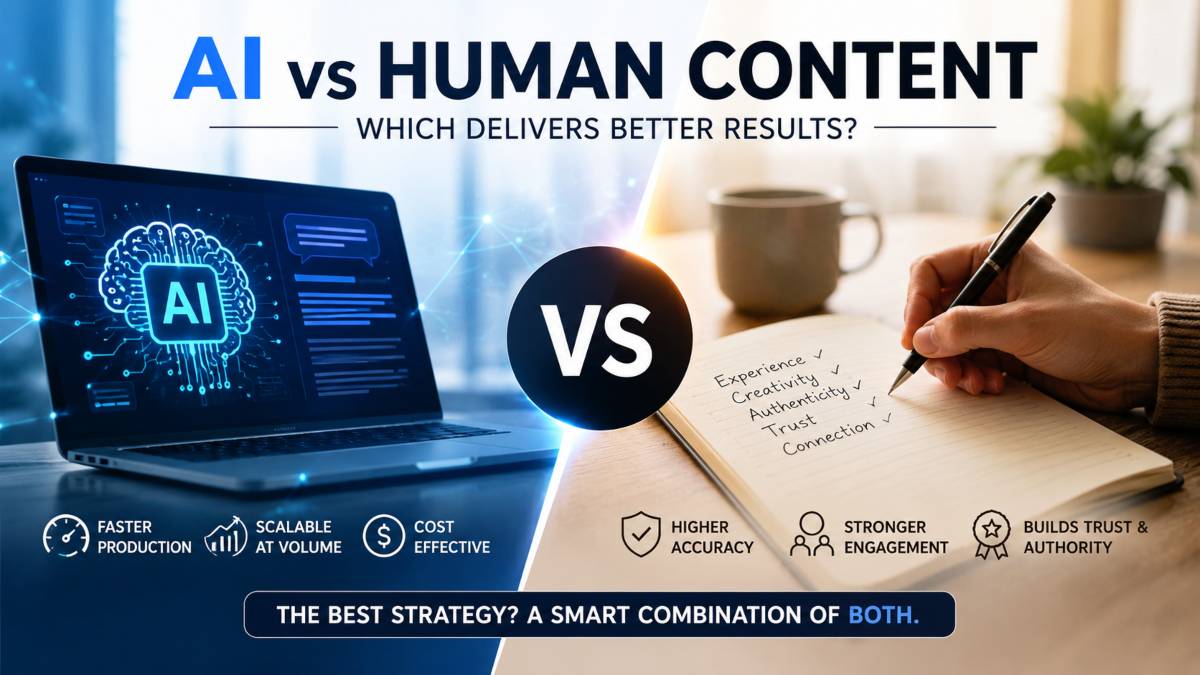
Artificial intelligence has changed the way businesses create content. From blog posts and product descriptions to email campaigns and social media captions, AI writing tools are helping marketers produce content faster than ever before. As these tools become more advanced, many companies are asking the same question: can AI content match the quality and performance of human writing?
The debate around AI vs human content has grown as brands look for ways to increase traffic, improve search visibility, and generate more conversions while managing costs. Some businesses rely heavily on AI to speed up content production, while others believe human writers remain essential for creating content that connects with readers and builds trust.
When it comes to SEO, audience engagement, and business results, the answer is not always straightforward. AI offers speed and efficiency, but human writers bring creativity, experience, and judgment that technology cannot fully replicate.
In this guide, we compare AI generated content and human written content across search rankings, organic traffic, conversions, trust, and content quality. You’ll also learn where each approach performs best and why many businesses are turning to a hybrid strategy that combines the strengths of both.
Understanding AI Content and Human Content
The rise of artificial intelligence has transformed content creation. Businesses now have access to tools that can generate articles, marketing copy, emails, and social media posts within minutes. At the same time, professional writers continue to create content built on experience, expertise, and creative thinking. Understanding the difference between AI generated content and human written content is essential for anyone looking to improve SEO performance, audience engagement, and business results.
What Is AI Generated Content?
AI generated content refers to text created by artificial intelligence software using machine learning and large language models. These systems analyze vast amounts of information and generate content based on patterns found in existing data.
Popular AI writing tools include ChatGPT, Claude, Gemini, Jasper, and Copy.ai. Businesses use these platforms to create blog outlines, articles, product descriptions, email campaigns, ad copy, and social media content.
One of AI’s biggest strengths is speed. A task that may take a writer several hours can often be completed by an AI tool in minutes. This makes AI useful for content production at scale, brainstorming ideas, and creating first drafts that can later be refined by human editors.
What Is Human Written Content?
Human written content is created by people who bring personal experience, industry knowledge, critical thinking, and creativity to the writing process.
Unlike AI, human writers can draw from real world experiences, unique perspectives, and emotional understanding. They can identify subtle audience needs, adjust tone based on context, and create content that feels authentic and relatable.
Human writers also apply editorial judgment throughout the content creation process. They evaluate facts, verify information, and make strategic decisions about structure, messaging, and storytelling. This level of original thinking often results in content that is more engaging and memorable.
Why the Debate Matters
The discussion around AI vs human content has become increasingly important as businesses compete for attention online. Search engines are filled with millions of articles covering similar topics, making it harder for brands to stand out.
SEO competition continues to increase across nearly every industry. Companies want content that ranks well, attracts visitors, and turns readers into customers.
At the same time, content creation budgets and publishing demands continue to grow. Businesses must balance speed, quality, trust, and return on investment. This challenge is what keeps the AI versus human content debate at the center of modern content marketing discussions.
AI vs Human Content at a Glance
The debate between AI content and human written content often comes down to one question: which approach delivers better business results? While artificial intelligence can create content quickly and at a lower cost, performance data suggests that human created content still leads in several areas that matter most, including organic traffic, search visibility, audience engagement, and conversions.
That does not mean AI has no place in content marketing. In many cases, businesses are finding success by combining AI’s speed with human expertise. To understand the differences, it helps to compare how each approach performs across key metrics.
Side by Side Performance Comparison
| Metric | Human Content | AI Assisted Content | Pure AI Content |
|---|---|---|---|
| Organic Traffic | Highest | Moderate | Lowest |
| Search Rankings | Stronger average rankings | Moderate | Weaker rankings |
| Conversion Rates | Highest conversion potential | Moderate performance | Lowest conversion rates |
| Audience Engagement | Higher trust and interaction | Moderate engagement | Lower engagement |
| Production Speed | Slower creation process | Faster workflow | Fastest production |
| Content Costs | Higher investment | Balanced costs | Lowest costs |
Human written content typically performs better because it offers greater depth, originality, and relevance. Readers are more likely to engage with content that reflects genuine expertise and real world understanding.
AI content excels when speed and scale are the primary goals. Businesses can publish more content in less time, making it useful for content support and initial drafting.
Key Findings From Recent Studies
Several studies comparing AI and human content reveal a consistent pattern. Human written content generates more organic traffic, earns stronger search rankings, and produces higher conversion rates than pure AI content.
Research also suggests that readers respond more positively to content that feels authentic and trustworthy. Human writers can provide context, examples, and nuanced explanations that improve the overall user experience.
Perhaps the most interesting finding is the success of the hybrid approach. AI assisted content that undergoes thorough human editing often performs better than content created entirely by AI. This model combines the efficiency of artificial intelligence with the creativity, judgment, and expertise of human writers.
AI vs Human Content Comparison Table
The evidence points to a clear conclusion. Human content remains the strongest performer for SEO, engagement, and conversions, while AI offers unmatched speed and scalability. For many businesses, the most practical solution is a human led strategy supported by AI tools, allowing teams to produce quality content without sacrificing efficiency.
Why Human Written Content Delivers Better Results
Artificial intelligence has made content creation faster and more accessible than ever before. Businesses can now generate articles, product descriptions, email campaigns, and social media posts within minutes. Yet when it comes to long term SEO performance, audience engagement, trust, and conversions, human written content continues to outperform content created entirely by AI.
The reason is simple. Human writers bring qualities that machines cannot fully replicate, including personal experience, critical thinking, creativity, and emotional understanding. These strengths help create content that resonates with readers and delivers stronger business outcomes.
Stronger Organic Search Performance
One of the biggest advantages of human written content is its ability to perform well in search results.
Search engines aim to provide users with the most useful and relevant information available. Human writers are often better equipped to create content that answers questions thoroughly, addresses user intent, and provides meaningful value beyond basic information.
As a result, human created content frequently achieves higher search rankings than content generated solely by AI. Experienced writers can build comprehensive articles that cover topics from multiple angles while maintaining a natural flow and logical structure.
Human writers also tend to create content with greater topical depth. Instead of repeating commonly available information, they can include expert opinions, industry knowledge, examples, and practical advice that enrich the reader experience.
This added depth makes content more useful, which can improve engagement metrics such as time on page and user satisfaction. Over time, these factors contribute to stronger organic search performance.
Greater Creativity and Originality
Creativity remains one of the clearest differences between human writers and artificial intelligence.
AI generates content by identifying patterns in existing information. Human writers, on the other hand, can combine knowledge, personal experiences, emotions, and imagination to create something genuinely distinctive.
A writer who has worked in an industry, solved real problems, or experienced specific challenges can bring unique perspectives that machines simply do not possess. These perspectives help transform ordinary content into something memorable and engaging.
Storytelling is another area where human writers excel. Whether sharing lessons learned, customer experiences, or industry observations, storytelling creates emotional engagement that keeps readers interested.
Original content also helps brands stand apart in crowded markets. When hundreds of websites publish similar information, unique viewpoints often become the factor that captures attention and encourages readers to return.
Higher Accuracy and Reliability
Accuracy is essential for building trust and maintaining credibility.
Although AI tools have improved significantly, they can still generate incorrect information, misunderstand context, or present unsupported claims with confidence. These mistakes can damage a brand’s reputation and reduce the value of its content.
Human writers are more likely to verify facts, review sources, and evaluate information before publication. They can identify inconsistencies, recognize questionable claims, and make informed decisions about what should or should not be included.
Another advantage is contextual understanding. Human writers can recognize subtle differences in audience expectations, industry terminology, and cultural references. This helps create content that feels more relevant and appropriate for its intended audience.
When readers trust the information they are consuming, they are more likely to continue engaging with the content and the brand behind it.
Stronger Audience Trust
Trust is one of the most valuable assets in content marketing.
People naturally connect with content that feels authentic, thoughtful, and human. Readers want to know that the information they consume comes from knowledgeable sources that understand their challenges and goals.
Human written content helps build brand credibility because it reflects expertise and genuine understanding. It demonstrates that time, effort, and knowledge have been invested in creating something useful.
Authority also grows when businesses consistently publish high quality content backed by experience and evidence. Readers are more likely to view a brand as a trusted resource when its content provides clear answers and meaningful guidance.
This trust often leads to stronger relationships with audiences. Readers who trust a brand are more likely to subscribe to newsletters, return for future content, and recommend the brand to others.
Better Conversion Rates
While traffic and rankings are important, conversions ultimately determine whether content contributes to business growth.
Human written content often generates stronger conversion rates because it connects with readers on both a logical and emotional level. Skilled writers understand how to address concerns, answer objections, and guide readers toward action.
Emotional connection plays a major role in decision making. Whether someone is purchasing software, signing up for a service, or downloading a resource, emotions frequently influence the final choice.
Human writers can create persuasive messages that feel natural rather than formulaic. They understand how to build trust, communicate value, and present solutions in ways that resonate with specific audiences.
This ability to combine information, emotion, and persuasion helps explain why human written content consistently produces stronger business results. While AI can support the content creation process, the human element remains a key factor in turning readers into customers.
For businesses focused on SEO, engagement, credibility, and revenue, human written content continues to deliver a level of quality and performance that pure AI content struggles to match.
Where AI Content Has a Clear Advantage
While human written content often delivers stronger results in areas such as trust, engagement, and conversions, artificial intelligence offers advantages that are difficult to ignore. Businesses operating in competitive markets frequently need to publish content quickly, manage large content libraries, and work within limited budgets. In these situations, AI can become a valuable asset.
Rather than replacing human writers, AI often serves as a productivity tool that helps content teams work faster and more efficiently. Its strengths are most noticeable in speed, scalability, cost management, and content planning.
Faster Content Production
One of AI’s biggest advantages is speed.
A human writer may spend hours researching, outlining, drafting, and revising an article. AI can generate a draft in a matter of seconds. This ability allows businesses to move from idea to content much faster than traditional workflows.
For content teams handling multiple projects, reduced turnaround times can create significant operational benefits. Marketing campaigns can launch more quickly, content calendars can be filled faster, and urgent content requests can be addressed without lengthy delays.
AI is particularly useful during the early stages of content creation. It can produce first drafts, generate topic ideas, suggest headlines, and create rough outlines that writers can refine later. This helps reduce time spent on repetitive tasks and allows content creators to focus on strategy, quality, and audience engagement.
For organizations that publish frequently, speed can become a competitive advantage.
Content Scalability
Creating content at scale is another area where AI performs exceptionally well.
As businesses grow, their content needs often expand. A company may need blog posts, landing pages, product descriptions, email campaigns, knowledge base articles, and social media content all at the same time.
Managing this volume with a small team can be difficult. AI helps bridge the gap by generating large amounts of content quickly and consistently.
Content marketers can use AI to support topic expansion, content updates, localization efforts, and large publishing schedules. Instead of spending weeks creating foundational content, teams can produce drafts rapidly and allocate more time to editing and optimization.
This scalability is particularly valuable for businesses managing extensive websites or targeting multiple audiences across different channels.
Lower Production Costs
Cost is another reason many companies adopt AI content tools.
Hiring experienced writers, editors, and subject matter experts can require a significant investment. While high quality content remains worth the expense, not every organization has the budget to support large content teams.
AI tools provide a more affordable option for generating content drafts and supporting routine content tasks. Businesses can create more content without increasing staffing costs at the same pace.
This does not mean AI should replace human expertise entirely. Instead, many organizations use AI to handle repetitive work while human writers focus on areas that require creativity, accuracy, and strategic thinking.
The result is a more efficient use of resources and a lower overall cost per piece of content.
Research and Content Planning Support
Beyond writing, AI can be extremely useful during the planning phase of content creation.
Content teams often spend considerable time researching topics, organizing ideas, and building content strategies. AI can simplify many of these tasks by generating outlines, identifying related topics, and suggesting content clusters around a specific keyword.
For SEO professionals, AI can assist with topic clustering by grouping related search terms and identifying content opportunities. This helps create a more organized content strategy and supports stronger topical authority.
AI can also generate content briefs that provide structure before the writing process begins. These briefs may include suggested headings, common questions, keyword opportunities, and topic ideas.
When used correctly, AI functions as a research assistant that helps content creators organize information more efficiently. This allows writers and marketers to spend less time on preparation and more time creating content that delivers meaningful results.
Although AI may not consistently outperform human writers in quality, it offers undeniable advantages in speed, scale, affordability, and planning support. These strengths explain why many businesses now use AI as part of their content workflow, even when human expertise remains at the center of the final product.
The Biggest Weaknesses of AI Generated Content
Artificial intelligence has transformed content creation by making it faster and more accessible. However, speed alone does not guarantee quality. While AI can produce large amounts of content quickly, it still struggles in several areas that directly influence SEO performance, audience engagement, and brand credibility.
Many of the limitations associated with AI generated content stem from the fact that machines do not think, feel, or understand information the same way humans do. As a result, content created entirely by AI often lacks the depth, originality, and context needed to stand out in competitive markets.
Generic Writing Patterns
One of the most common issues with AI generated content is its tendency to produce repetitive and predictable writing.
Because AI systems learn from existing data, they often rely on familiar sentence structures, common phrases, and widely available information. This can make articles feel similar to countless other pieces of content published online.
Readers may notice repeated patterns in introductions, explanations, and conclusions. Over time, this can create a formulaic reading experience that lacks personality and distinction.
Another challenge is originality. AI can reorganize existing information, but it rarely produces truly unique ideas or fresh perspectives. As more businesses publish AI generated content, the risk of creating content that blends into the crowd becomes even greater.
For brands trying to establish authority and differentiation, generic content can limit visibility and reduce audience engagement.
Limited Human Perspective
Content is often most valuable when it reflects real experiences and practical knowledge. This is an area where AI faces significant limitations.
Human writers can share lessons learned, industry observations, personal stories, and firsthand experiences. These elements add depth and authenticity that readers appreciate.
AI cannot draw from personal experiences because it has never managed a business, worked with customers, or faced real world challenges. It can only generate responses based on patterns found in existing information.
This limitation often results in reduced emotional depth. While AI can mimic conversational language, it struggles to create genuine emotional connections with readers.
People naturally respond to content that feels authentic and relatable. Without a human perspective, articles may appear informative but lack the emotional qualities that keep audiences engaged and invested.
Accuracy Risks
Accuracy remains one of the biggest concerns surrounding AI generated content.
Although AI tools can process vast amounts of information, they are not immune to mistakes. In some cases, they may generate fabricated facts, incorrect statistics, or misleading statements that appear convincing at first glance.
These errors occur because AI predicts likely responses rather than verifying information in real time. Without careful human review, inaccurate content can reach publication and damage a brand’s credibility.
Another issue involves outdated information. AI models may rely on older training data that does not reflect current events, recent industry developments, or updated regulations.
For businesses operating in fields such as finance, healthcare, technology, or law, even small inaccuracies can create serious consequences. This is why fact checking and editorial review remain essential parts of the content creation process.
Trust Challenges
Trust is difficult to earn and easy to lose.
Many readers are becoming more aware of AI generated content and are learning to recognize common signs of machine written text. When content feels overly generic or lacks depth, audiences may question its credibility.
Some studies suggest that readers evaluate content more critically when they know it was created by artificial intelligence. This can affect engagement, brand perception, and willingness to act on recommendations.
AI disclosure has also become a topic of discussion among marketers and consumers. While transparency is generally viewed positively, openly labeling content as AI generated may influence how some audiences perceive its quality and reliability.
For brands that depend on authority and trust, these concerns cannot be ignored. Readers want accurate information, genuine expertise, and content that reflects a clear understanding of their needs.
AI remains a powerful tool for content creation, but its limitations highlight the continued importance of human oversight. Without editing, fact checking, and strategic guidance from experienced writers, AI generated content can struggle to achieve the same level of quality, credibility, and audience connection as human written content.
The Hybrid Content Model: Best of Both Worlds?
As businesses search for ways to balance quality, efficiency, and scalability, many are turning to a hybrid content model. Rather than choosing between AI and human writers, this approach combines the strengths of both. AI handles time consuming tasks such as drafting and research support, while humans refine, verify, and improve the final content.
The result is a workflow that can reduce production time without sacrificing the quality readers and search engines expect. For many organizations, the hybrid model has become the most practical solution in modern content marketing.
What Is AI Assisted Content?
AI assisted content refers to content that is created through collaboration between artificial intelligence tools and human writers.
In this model, AI is not responsible for the final product. Instead, it acts as a support tool that helps generate ideas, create outlines, produce drafts, and organize information. Human writers then review and improve the content before publication.
This approach differs significantly from publishing content generated entirely by AI. Human involvement remains central throughout the process, ensuring that the final piece reflects expertise, accuracy, creativity, and audience needs.
Many content teams now view AI as a productivity partner rather than a replacement for skilled writers.
How the Hybrid Workflow Works
A successful hybrid workflow combines automation with human judgment at every stage of content creation.
The process often begins with AI drafting. Writers provide prompts, target keywords, audience details, and content goals. The AI then generates an outline or initial draft that serves as a foundation for further development.
Once the draft is complete, human editors step in. This stage is critical because AI generated content frequently requires improvements in clarity, structure, and flow. Editors remove repetitive sections, strengthen arguments, and add valuable context where needed.
Fact checking is another essential part of the process. Human reviewers verify statistics, examples, quotes, and claims to ensure the content is accurate and reliable. This step helps prevent the publication of incorrect or outdated information.
The final stage involves brand voice refinement. Every business has its own style, tone, and messaging standards. Human writers adjust the content to match these requirements, ensuring consistency across all marketing channels.
By combining AI efficiency with human expertise, businesses can produce content that feels authentic while maintaining a faster production cycle.
Why Many Businesses Are Adopting Hybrid Content
The growing popularity of hybrid content is driven by practical business needs.
Content marketing demands continue to increase. Companies are expected to publish blog posts, landing pages, newsletters, social media content, and educational resources on a regular basis. Meeting these demands using only traditional workflows can be expensive and time consuming.
The hybrid model helps solve this challenge by reducing the amount of time spent on early stage content creation. Teams can move from idea to first draft much faster while still maintaining editorial standards.
Businesses also recognize that pure AI content often struggles with trust, originality, and engagement. Human involvement helps address these weaknesses while preserving the speed advantages that AI provides.
Another reason for adoption is resource management. Instead of replacing writers, organizations can allow content teams to focus on strategy, creativity, audience research, and content optimization while AI supports repetitive tasks.
This balance makes the hybrid approach attractive for startups, agencies, SaaS companies, ecommerce brands, and enterprise organizations alike.
Examples of Successful AI Assisted Content Strategies
Many organizations already use hybrid content workflows successfully.
One common strategy involves using AI to generate blog outlines and topic ideas. Writers then expand those outlines with expert commentary, examples, case studies, and original analysis. This approach speeds up planning while maintaining content quality.
Another effective method is using AI to create first drafts for routine content such as product descriptions, frequently asked questions, and knowledge base articles. Human editors then refine the content, correct errors, and adapt it to the brand’s voice.
SEO teams often use AI for keyword clustering, content briefs, and content gap analysis. These tasks can take hours when done manually, but AI can organize large amounts of information quickly. Writers then use those insights to create more useful and engaging content.
Some businesses also rely on AI to update existing articles by identifying sections that need expansion or improvement. Human writers review the recommendations and make strategic updates that improve relevance and user experience.
The strongest results typically come from businesses that treat AI as a support tool rather than a replacement for human expertise. When technology and human creativity work together, companies can achieve a balance of speed, quality, and consistency that neither approach can deliver on its own.
How Google Evaluates AI Content
As artificial intelligence becomes a larger part of content creation, many marketers and business owners wonder how Google views AI generated content. A common concern is whether content created with AI can rank in search results or whether Google automatically favors content written by humans.
The reality is more nuanced. Google does not judge content based solely on how it was created. Instead, it focuses on the quality, usefulness, and reliability of the information provided to users.
Understanding Google’s approach can help businesses use AI responsibly while maintaining strong SEO performance.
Google’s Position on AI Generated Content
Google has made it clear that the method used to create content is not the primary factor in ranking decisions. Whether content is written by a human, generated with AI, or produced through a combination of both, Google’s goal remains the same: deliver helpful and relevant information to searchers.
The search engine evaluates content based on its value to users rather than its origin. This means AI generated content is not automatically penalized simply because artificial intelligence was involved in the creation process.
However, Google does discourage content created primarily to manipulate search rankings. Content that lacks substance, repeats existing information, or provides little value to readers may struggle to perform regardless of whether it was written by a person or a machine.
Quality Over Content Origin
Google’s ranking systems are designed to identify content that best satisfies user intent. As a result, quality matters far more than the tool used to produce the content.
A well researched and carefully edited AI assisted article can perform better than a poorly written human article. Likewise, a low quality AI generated page may perform poorly if it offers little value to readers.
Search engines reward content that answers questions clearly, demonstrates knowledge of the topic, and provides useful information that users cannot easily find elsewhere.
For businesses, this means the focus should remain on creating content that serves readers first. The content creation method is secondary to the overall quality of the final result.
E-E-A-T and Content Quality Signals
One of the most important concepts in modern SEO is E-E-A-T, which stands for Experience, Expertise, Authority, and Trustworthiness.
Experience refers to firsthand knowledge of a topic. Content that reflects real world involvement often provides greater value to readers.
Expertise involves demonstrating a strong understanding of the subject being discussed. This is particularly important in industries where accuracy matters.
Authority is built when a website consistently publishes reliable information and becomes recognized as a trusted source within its niche.
Trustworthiness focuses on accuracy, transparency, and credibility. Readers and search engines both favor content they can rely on.
These signals help Google determine whether content deserves strong visibility in search results. Human writers often have an advantage because they can draw from direct experience and professional knowledge, but AI assisted content can also perform well when guided by experts and reviewed carefully.
What Causes AI Content to Perform Poorly
AI generated content typically performs poorly when it lacks originality, depth, or accuracy.
Common issues include repetitive wording, shallow explanations, factual errors, and content that closely resembles information already available online. Pages that fail to satisfy user intent are unlikely to earn strong rankings over time.
Another problem occurs when businesses publish large volumes of AI content without human review. This can lead to inconsistent quality, weak audience engagement, and reduced trust.
The most successful content strategies focus on quality control. Human oversight, fact verification, audience understanding, and clear editorial standards help ensure that AI assisted content meets the expectations of both readers and search engines.
For Google, the question is not whether content was written by AI or a human. The real question is whether the content is useful, accurate, and worthy of ranking.
AI vs Human Content for SEO
Search engine optimization is one of the most important factors in the AI versus human content discussion. Businesses invest significant time and resources into content because they want higher rankings, increased organic traffic, and more qualified leads. The question is whether AI generated content can achieve the same SEO success as human written content.
While AI can assist with content production and research, current evidence suggests that human written content still performs better across several SEO related areas. However, the gap becomes smaller when AI content is carefully edited and enhanced by human experts.
Search Rankings
Search rankings are often the first metric marketers examine when evaluating content performance.
Multiple studies have found that human written content tends to achieve stronger average rankings than content created entirely by AI. This is largely because human writers are better at creating detailed, useful content that addresses user intent comprehensively.
Search engines reward pages that answer questions clearly, provide unique value, and satisfy reader expectations. Human writers can adapt their writing to audience needs, add original observations, and create content that feels more natural.
Pure AI content often struggles when it relies on predictable structures and information already available across the web. If content lacks originality or depth, it becomes harder for search engines to view it as the best result for a query.
That said, AI assisted content can perform well when human editors improve quality, accuracy, and relevance before publication.
Topical Authority
Topical authority refers to a website’s ability to demonstrate deep knowledge across a specific subject area.
Building authority requires more than publishing large quantities of content. It requires creating interconnected articles that answer important questions, provide expert guidance, and cover topics in meaningful depth.
Human writers often excel in this area because they can connect concepts, provide nuanced explanations, and share practical examples that strengthen topic coverage.
AI can help identify related keywords and content opportunities, but creating genuine authority usually requires human expertise. Readers and search engines are more likely to trust websites that publish content based on experience and subject matter knowledge.
Websites that combine expert insights with strong content planning often develop stronger topical authority than sites relying solely on automated content production.
User Experience Signals
SEO is no longer focused only on keywords. User experience plays an increasingly important role in content performance.
When visitors land on a page, search engines evaluate signals that indicate whether the content meets user expectations. These signals may include engagement levels, time spent reading, and overall content usefulness.
Human written content frequently performs better because it is more engaging and easier to connect with. Strong storytelling, clear explanations, and audience focused writing encourage readers to stay longer and explore additional content.
AI generated articles can sometimes feel repetitive or generic, which may reduce engagement. If readers quickly leave a page because the content does not meet their needs, search engines may interpret this as a sign that the page is less valuable.
Content that keeps readers interested and provides meaningful answers generally has a stronger chance of achieving long term SEO success.
Content Freshness and Relevance
Freshness and relevance remain important ranking factors, particularly in industries where information changes frequently.
AI offers a clear advantage when it comes to content updates and content production speed. Businesses can use AI tools to identify outdated sections, generate update suggestions, and support ongoing content maintenance.
However, relevance involves more than publishing new content. Writers must understand audience concerns, industry developments, and search intent shifts.
Human creators are often better at recognizing emerging trends, interpreting market changes, and adjusting content strategies accordingly. They can evaluate whether information is still useful and determine what updates are necessary to maintain relevance.
The strongest SEO results often come from combining AI’s efficiency with human oversight.
Which Content Type Wins for SEO?
When comparing AI and human content for SEO, the evidence points to a clear winner.
Human written content generally achieves better rankings, stronger topical authority, higher engagement, and greater trust from readers. These factors contribute directly to long term organic search success.
AI remains valuable as a support tool. It can accelerate research, assist with outlines, generate drafts, and help scale content operations. However, content produced entirely by AI often struggles to match the quality and depth that search engines reward.
For most businesses, the best approach is a human led strategy supported by AI. This model combines efficiency with expertise, allowing teams to create content that ranks well while maintaining accuracy, originality, and audience value.
From an SEO perspective, human content continues to hold the advantage, but AI can become a powerful ally when used thoughtfully within the content creation process.
AI vs Human Content for Conversions and Engagement
Generating traffic is only one part of a successful content strategy. Businesses ultimately want content that encourages readers to take action, whether that means signing up for a newsletter, requesting a demo, making a purchase, or becoming a long term customer.
This is where conversions and engagement become critical metrics. While AI can help produce content quickly, human written content often performs better when the goal is to build relationships, earn trust, and influence decisions. The difference comes down to how people respond to the content they consume.
Conversion Rate Comparison
Conversion rates measure how successfully content turns visitors into leads or customers.
Research comparing AI and human content has found a noticeable gap in conversion performance. Human written content generally achieves higher conversion rates because it communicates with greater clarity, relevance, and persuasion.
Experienced writers understand how to address customer concerns, explain benefits, and guide readers through the decision making process. They know how to create messaging that feels natural rather than mechanical.
AI generated content can communicate information efficiently, but it often struggles to create the same level of persuasive impact. Without careful editing, AI content may feel generic or fail to address the specific motivations that drive customer actions.
This difference becomes especially important for landing pages, sales content, product pages, and other conversion focused assets where every interaction matters.
User Trust and Brand Perception
Trust is one of the strongest influences on engagement and conversions.
People are more likely to interact with content and buy from brands they believe are credible. Human written content tends to strengthen this credibility because it reflects expertise, authenticity, and a deeper understanding of audience needs.
Readers often recognize when content feels overly generic or lacks genuine insight. In many cases, this can influence how they perceive the brand behind the content.
Brand perception is shaped by every piece of content a company publishes. High quality articles, thought leadership pieces, case studies, and educational resources help establish authority and encourage long term trust.
When audiences trust a brand, they are more willing to engage with its content, share it with others, and consider its products or services.
Engagement Metrics
Engagement metrics help measure how audiences interact with content after arriving on a page.
These metrics may include time spent reading, page views, comments, social shares, email signups, and return visits. Strong engagement often indicates that content is relevant, useful, and interesting to readers.
Human written content typically performs well because it creates a more enjoyable reading experience. Storytelling, examples, personal observations, and thoughtful explanations help maintain attention and encourage readers to continue exploring.
AI generated content can sometimes struggle in this area because of repetitive phrasing, predictable structures, or a lack of unique perspectives. Even when the information is accurate, readers may lose interest if the content feels formulaic.
The more engaged readers become, the more likely they are to develop a relationship with the brand and take meaningful action.
Customer Decision Making
Most purchasing decisions involve more than facts and features.
People often evaluate products and services based on trust, confidence, perceived value, and emotional connection. Content plays a major role in shaping these perceptions.
Human writers are generally better equipped to understand customer psychology and create content that speaks directly to audience concerns. They can anticipate objections, answer important questions, and provide reassurance throughout the buyer journey.
AI can organize information and generate content quickly, but it often lacks the nuanced understanding required to influence complex decisions. This is particularly true for high value purchases where customers need confidence before making a commitment.
When the goal is to move readers from interest to action, human written content continues to hold a clear advantage. Its ability to build trust, create engagement, and support decision making makes it one of the most valuable tools for driving conversions and long term business growth.
Which Content Strategy Is Right for Your Business?
There is no single content strategy that works for every business. The right approach depends on your goals, audience, budget, industry, and content requirements. While some organizations benefit most from expert human writers, others may gain efficiency from AI tools. Many businesses are finding that a combination of both delivers the strongest results.
Understanding when to use human content, AI content, or a hybrid model can help maximize return on investment while maintaining quality and consistency.
When Human Written Content Makes Sense
Human written content is often the best choice when quality, credibility, and persuasion are top priorities.
Thought leadership content is a strong example. Industry experts and business leaders need content that reflects personal experience, original viewpoints, and professional expertise. These qualities help establish authority and build trust with audiences.
Case studies also benefit from human involvement. Effective case studies require storytelling, customer context, and a detailed understanding of results. Human writers can present these elements in a way that feels authentic and convincing.
High value landing pages are another area where human content performs well. These pages often serve as the first impression for potential customers and must communicate value clearly while encouraging action.
Sales content also relies heavily on human understanding. Persuasive messaging, customer psychology, and audience specific communication are areas where experienced writers continue to hold a significant advantage.
When AI Content Makes Sense
AI content can be highly useful when speed and efficiency are the primary goals.
Content ideation is one of the most valuable applications. AI can quickly generate topic suggestions, headline ideas, and content angles that help teams overcome creative blocks and accelerate planning.
Draft generation is another practical use case. AI can create initial versions of blog posts, product descriptions, email campaigns, and other content assets. These drafts provide a starting point that writers can refine and improve.
Content updates are also well suited for AI assistance. Businesses managing large content libraries can use AI to identify outdated sections, suggest revisions, and support content refresh initiatives.
When used strategically, AI can reduce production time and free up resources for higher value activities.
When a Hybrid Approach Works Best
For many organizations, the hybrid model offers the most balanced solution.
Blogs are a common example. AI can assist with research, outlines, and draft creation, while human writers add expertise, examples, and editorial refinement. This combination helps maintain quality without slowing production.
SaaS companies often use hybrid workflows to support content marketing efforts. AI can streamline content creation, while subject matter experts ensure accuracy and relevance for technical audiences.
Content marketing campaigns also benefit from this approach. Teams can produce content more efficiently while maintaining a consistent brand voice and strong messaging.
SEO programs are another area where hybrid content performs well. AI can help with keyword research, topic clustering, and content briefs, while human writers create valuable content that satisfies user intent and supports long term rankings.
Ultimately, the best strategy depends on your business objectives. Human content delivers stronger trust, engagement, and conversions. AI provides speed and scalability. A hybrid approach combines the strengths of both, allowing businesses to create content that is efficient, useful, and capable of producing meaningful results.
Final Verdict
After comparing SEO performance, engagement, conversions, trust, scalability, and production efficiency, one conclusion stands out: human written content continues to deliver stronger overall results for most businesses.
While artificial intelligence has transformed content creation, it has not replaced the qualities that make content truly valuable. Readers still respond to authenticity, expertise, creativity, and real world experience. These are areas where human writers maintain a clear advantage.
Key Takeaways
The evidence shows that human content generally performs better in search rankings, organic traffic, audience engagement, and conversion rates. AI, however, offers significant benefits in speed, content production, and workflow efficiency.
Businesses that understand the strengths and limitations of both approaches are better positioned to build successful content strategies.
Why Human Content Still Leads
Human writers create content with depth, originality, and context. They understand audience emotions, communicate ideas more persuasively, and build stronger connections with readers.
These qualities help generate trust, strengthen brand authority, and encourage meaningful actions. For businesses focused on long term growth, human expertise remains one of the most valuable assets in content marketing.
Why AI Remains a Valuable Tool
AI excels at accelerating content workflows. It can assist with brainstorming, outlining, research support, draft creation, and content updates.
When used responsibly, AI allows teams to work faster and manage larger content operations without sacrificing productivity.
The Future of Content Creation
The future is unlikely to be a choice between AI and human writers. Instead, the most successful organizations will combine both. Human expertise will guide strategy, creativity, and decision making, while AI will support efficiency and scalability.
As content marketing continues to evolve, the strongest results will come from businesses that use technology to enhance human capabilities rather than replace them.