

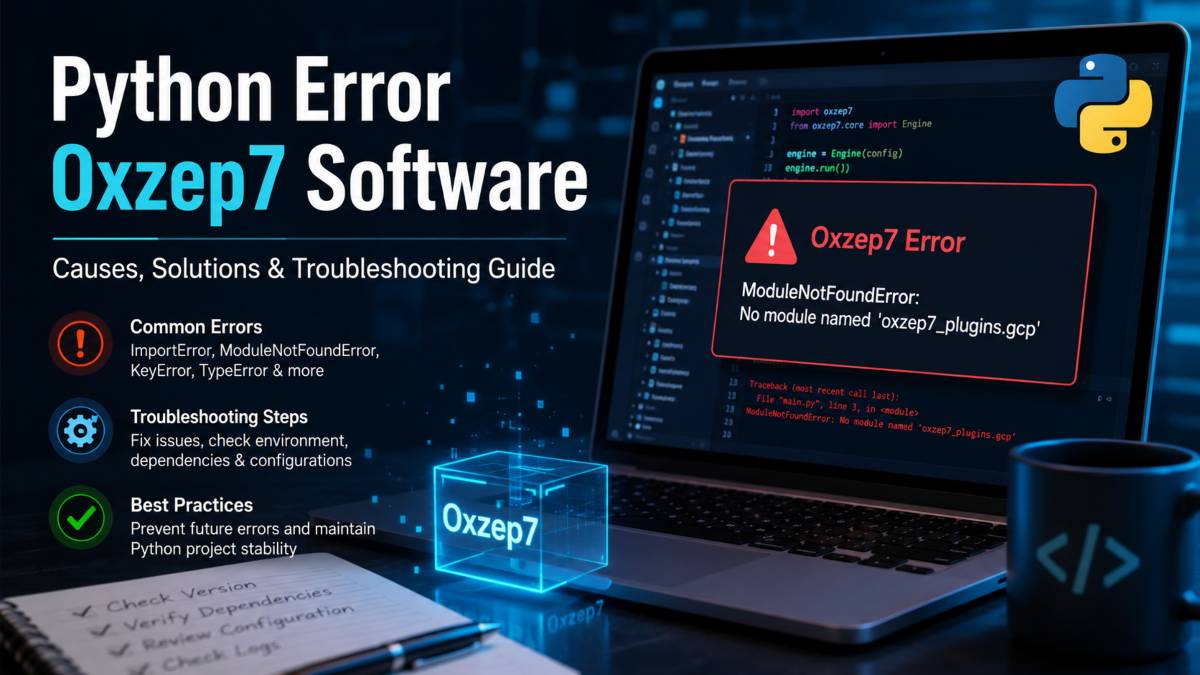
If you searched for “Python Error Oxzep7 Software,” chances are you ran into a frustrating issue while working with the Oxzep7 platform or one of its related Python packages. The good news is that this is not an official Python error. Unlike familiar exceptions such as ImportError, TypeError, or ModuleNotFoundError, “Oxzep7” is not a built in Python error message. Instead, it is a term commonly used by developers when problems occur within the Oxzep7 ecosystem.
These issues can appear for several reasons, including package installation failures, version incompatibilities, missing configuration settings, outdated modules, or changes introduced after software updates. Since Oxzep7 is designed to support development, automation, debugging, and deployment workflows, even a small configuration mistake can trigger unexpected errors.
Understanding the root cause is the first step toward fixing the problem. This guide explains what the Python Error Oxzep7 Software actually means, why it occurs, and how to resolve the most common issues users encounter. You will also learn practical troubleshooting methods, proven fixes, and preventive measures that can help keep your Python projects running smoothly.
What Is the Python Error Oxzep7 Software?
The term “Python error Oxzep7 software” often causes confusion because it sounds like a specific Python exception. In reality, it is not an official error recognized by Python. Instead, the phrase is commonly used by developers and users who encounter problems while working with the Oxzep7 Python platform or its related packages.
When an application fails to run correctly, users frequently associate the issue with Oxzep7 itself and search for solutions using phrases such as “Python error Oxzep7 software” or “Oxzep7 software error.” Understanding what this term actually means can make troubleshooting much easier.
Is Oxzep7 an Official Python Error?
No, Oxzep7 is not a built in Python exception. Python includes standard error types such as ImportError, ModuleNotFoundError, TypeError, ValueError, and SyntaxError. These exceptions are part of the Python language and appear when specific coding or runtime issues occur.
A common misconception is that Oxzep7 represents a unique Python error category. In most cases, the actual error is one of Python’s standard exceptions that happens while using an Oxzep7 related package, module, or feature. The Oxzep7 name simply becomes associated with the problem because the issue occurs within that environment.
What Is Oxzep7 Software?
Oxzep7 is described as a Python development platform that combines coding, debugging, automation, deployment, and optimization tools into a single environment. It is designed to support a variety of development tasks, including web applications, automation workflows, data processing projects, and enterprise software solutions.
The platform aims to simplify development by offering tools that help developers build, test, and manage Python based applications more efficiently.
Why Users Search for “Python Error Oxzep7 Software”
Most searches for Python error Oxzep7 software are triggered by technical issues that appear during installation or development. Common causes include failed package imports, compatibility conflicts after software updates, and missing environment configurations. Users may also encounter problems when modules are renamed, APIs change between versions, or required dependencies are not installed correctly.
Because these issues often generate standard Python exceptions, many users refer to them collectively as an Oxzep7 software error when looking for troubleshooting guidance.
Common Causes of Oxzep7 Python Errors
Most Oxzep7 related errors are not caused by a single bug or software failure. Instead, they usually result from compatibility mismatches, installation issues, configuration mistakes, or dependency related problems. Identifying the underlying cause is often the fastest way to resolve an error and restore normal functionality. Below are some of the most common reasons users encounter Oxzep7 Python errors.
Python Version Compatibility Problems
One of the leading causes of Oxzep7 compatibility issues is using an unsupported version of Python. Like many development platforms, Oxzep7 is designed to work with specific Python releases. Running the software on an older or newer version than recommended can trigger unexpected errors, failed imports, or broken functionality.
For example, certain libraries may rely on features introduced in newer Python versions, while older Oxzep7 components may not support recent language updates. Before troubleshooting more complex issues, it is always a good idea to verify that your Python version matches the platform’s requirements.
Missing or Corrupted Package Installations
Oxzep7 installation problems are another common source of errors. During installation, packages can become incomplete due to interrupted downloads, network issues, or dependency failures. In some cases, files may be accidentally deleted or corrupted after installation.
When this happens, users often encounter messages indicating that modules cannot be found or imported. Reinstalling the package in a clean virtual environment can often resolve these issues and restore missing components.
Deprecated Modules and API Changes
Software platforms evolve over time, and Oxzep7 is no exception. New releases may reorganize modules, rename functions, or remove older features. Code that worked perfectly with a previous version may fail after an update if the underlying API has changed.
These changes often result in ImportError or TypeError exceptions. Developers who upgrade without reviewing release notes may find that import paths, function names, or parameters no longer match the latest version of the platform.
Configuration and Environment Variable Issues
Many Oxzep7 applications depend on configuration files and environment variables to operate correctly. Missing settings, incorrect values, or incomplete configuration files can prevent the platform from loading required resources.
Errors may occur when authentication credentials, timeout settings, database connections, or application parameters are not properly defined. Validating configuration files and ensuring all required variables are available can help eliminate these problems.
Plugin and Dependency Conflicts
Modern Python applications often rely on multiple libraries and extensions working together. Python dependency conflicts can occur when two packages require different versions of the same library. Similarly, Oxzep7 plugins may fail if they are not compatible with the installed platform version.
Dependency related issues frequently appear after upgrades or when new packages are added to an existing environment. Using isolated virtual environments and carefully managing package versions can reduce the risk of conflicts and improve overall stability.
Here’s the next section written in your preferred style and structure.
Top 7 Python Error Oxzep7 Software Issues and How to Fix Them
When users search for “Python error Oxzep7 software,” they are usually dealing with one of several recurring technical problems. These issues often appear after software updates, package installations, configuration changes, or dependency modifications. While the error messages may seem intimidating at first, most have clear causes and practical solutions.
Below are the seven most common Oxzep7 related Python errors and the steps you can take to resolve them.
ImportError: No Module Named oxzep7.data
One of the most frequently reported issues occurs when Python cannot locate the oxzep7.data module.
Why This Error Happens
This error typically appears when the module structure has changed between versions or when the installed package is incomplete. A project created for an older release may reference import paths that no longer exist.
How to Fix It
Start by checking which version of Oxzep7 is installed on your system. Compare your version with the documentation used when the application was developed.
Next, inspect the package directory to verify whether the module still exists. If the package structure has changed, update your import statements to match the latest version.
If the project depends on legacy functionality, consider installing an earlier version that supports the original module path.
Function Signature Changed After an Upgrade
A software update can introduce changes to function parameters and method definitions.
Common Symptoms
You may see errors such as:
TypeError: process_data() got an unexpected keyword argument
This usually indicates that a function no longer accepts the same arguments as before.
How to Update Your Code
Review the current documentation and inspect the function signature. Compare the new parameters with the ones used in your application.
Update function calls to match the latest requirements. For larger projects, creating wrapper functions can help reduce future maintenance work by isolating third party changes from your application code.
ImportError: No Module Named oxzep7.ui
Many developers encounter this issue after upgrading to a newer release.
Understanding Deprecated Modules
Software vendors occasionally retire modules that are no longer actively maintained. The oxzep7.ui package may have been renamed, relocated, or removed entirely.
Recommended Solutions
Consult the release notes and migration documentation for the version you are using. Look for replacement modules or updated import paths.
If no direct replacement exists, you may need to redesign the affected portion of your application using supported components.
Adding defensive error handling during imports can also make troubleshooting easier when future changes occur.
Missing Environment Configuration Errors
Configuration related problems are responsible for a large percentage of deployment failures.
Common KeyError Examples
Errors often appear when required settings are absent from configuration files:
KeyError: 'timeout'
Similar issues may occur with database credentials, authentication tokens, or service endpoints.
Validating Configuration Files
Review all configuration files and environment variables before launching the application. Ensure required keys exist and contain valid values.
Many development teams create template files that list all required settings. This approach reduces mistakes during deployment and makes onboarding easier for new team members.
Adding startup validation checks can also help detect missing configuration values before the application reaches production.
Async API Compatibility Problems
As software evolves, developers often transition from synchronous processing to asynchronous execution models.
Sync and Async Mismatches
Problems occur when older code attempts to interact with newer asynchronous APIs. Functions that previously returned immediate results may now require asynchronous execution.
Common symptoms include runtime warnings, execution failures, or unexpected behavior during data processing.
Migration Tips
Identify whether the platform version you are using supports asynchronous workflows. If so, update your code to use asynchronous execution methods where required.
Testing in a development environment before deployment can prevent disruptions and reveal compatibility concerns early in the upgrade process.
For business critical applications, gradual migration strategies often reduce risk and allow teams to adapt incrementally.
Unsupported Data Format Errors
Data format changes can break applications even when the rest of the system remains unchanged.
Why This Happens
Some Oxzep7 releases may discontinue support for older formats in favor of newer standards. Applications that rely on unsupported formats may suddenly stop working after an update.
For example, a serializer configured for XML processing may fail if the platform now supports only JSON based workflows.
How to Resolve It
Review the list of supported formats in the current documentation. Update serializers, parsers, and data processing pipelines accordingly.
If legacy data formats remain necessary, implement a conversion layer that transforms incoming data into a supported format before processing.
This approach allows existing systems to continue functioning while maintaining compatibility with newer software versions.
ModuleNotFoundError: No Module Named ‘oxzep7_plugins.gcp’
Plugin related issues are common in projects that rely on optional integrations.
Why the Error Appears
Earlier versions of Oxzep7 may have included plugins as part of the main installation package. Newer releases often separate these components into individual packages.
As a result, the application may attempt to load a plugin that is no longer installed by default.
Installing Missing Plugins
Verify whether the required plugin exists as a standalone package. Install any missing components and update your dependency files to ensure they are included in future deployments.
If you use containers or automated build pipelines, confirm that plugin packages are installed during the build process.
Keeping dependency lists current helps prevent missing module errors when applications move between environments.
Preventing Recurring Oxzep7 Errors
While each issue has its own solution, several best practices can reduce the likelihood of future problems:
- Use virtual environments for every project.
- Pin package versions in dependency files.
- Test upgrades before deploying them.
- Maintain accurate documentation.
- Monitor release notes for breaking changes.
- Validate configuration files during startup.
- Run automated tests after dependency updates.
Most Oxzep7 related errors stem from version mismatches, missing dependencies, outdated imports, or configuration oversights. By following a structured troubleshooting process, developers can quickly identify the source of the problem and implement a reliable fix without wasting hours on trial and error.
Here’s a more detailed standalone subsection for that heading.
ImportError: No Module Named oxzep7.data
Among the most common Oxzep7 related issues, the ImportError: No Module Named oxzep7.data message appears when Python cannot locate the specified module within the installed Oxzep7 package. This error often occurs after upgrading the software, migrating projects between environments, or working with code written for an older release.
Because Oxzep7 continues to evolve, changes to its internal package structure can cause existing import statements to stop working. Fortunately, the issue is usually straightforward to diagnose and resolve.
Why This Error Happens
This error typically occurs when the oxzep7.data module is unavailable in the installed version of Oxzep7. In many cases, developers are working with code that was built for a previous release where the module existed under a different location.
Several factors can trigger this problem:
- The module was renamed or moved in a newer version.
- The installed Oxzep7 package is incomplete or corrupted.
- Multiple Oxzep7 versions exist on the same system.
- The virtual environment is not activated correctly.
- Project dependencies were upgraded without updating import statements.
- Required package files failed to install during setup.
When Python attempts to load a module that cannot be found, it raises an ImportError and prevents the application from continuing.
Step by Step Fix
Follow these troubleshooting steps to identify and resolve the issue.
1. Verify the Installed Oxzep7 Version
Check which version is currently installed:
pip show oxzep7
You can also review all installed packages:
pip freeze
Compare the installed version with the version used when the project was originally developed.
2. Confirm the Module Structure
Locate the Oxzep7 installation directory:
python -c "import oxzep7, os; print(os.path.dirname(oxzep7.__file__))"
Open the package folder and inspect the available submodules. If data is missing, the module may have been renamed or relocated.
3. Review the Documentation
Check the documentation or release notes for your installed version. Developers often discover that functionality previously located in oxzep7.data has been moved to another module.
For example:
from oxzep7.data import process
might become:
from oxzep7.core import process_data
Updating import statements can often solve the problem immediately.
4. Reinstall the Package
If the module should exist but does not appear in the installation directory, reinstall Oxzep7:
pip uninstall oxzep7
pip install oxzep7
This ensures all package files are downloaded and installed correctly.
5. Check Your Virtual Environment
Verify that the correct virtual environment is active before running your application.
python -m venv .venv
Activate the environment and reinstall dependencies if necessary. Many import related issues occur because developers accidentally use a different Python environment than the one where Oxzep7 is installed.
6. Roll Back to a Compatible Version
If your project depends on older functionality, installing a previous version may be the fastest solution.
pip install oxzep7==X.Y.Z
Replace X.Y.Z with a version known to support the required module structure.
7. Test the Import
After making changes, verify the fix with a simple import test:
import oxzep7
print("Oxzep7 loaded successfully")
If the script runs without errors, the module issue has likely been resolved.
By systematically checking version compatibility, package structure, installation integrity, and environment settings, most ImportError: No Module Named oxzep7.data issues can be fixed quickly and with minimal disruption to your project.
Function Signature Changed After an Oxzep7 Upgrade
Upgrading Oxzep7 can bring performance improvements, security updates, and new features. However, updates may also introduce changes to function signatures. When this happens, code that worked perfectly before the upgrade can suddenly begin throwing errors because the expected parameters, argument names, or function behavior have changed.
This is a common issue in actively maintained software platforms where developers regularly refine APIs to improve usability and performance.
Common Symptoms
A function signature change typically becomes apparent immediately after updating Oxzep7. The application may fail during execution even though no changes were made to the source code.
Common error messages include:
TypeError: process_data() got an unexpected keyword argument 'config'
TypeError: process_data() missing 1 required positional argument
TypeError: process() takes 2 positional arguments but 3 were given
You may also notice that previously accepted parameters no longer work, optional arguments become mandatory, or function names have changed entirely.
Some developers encounter these issues after updating project dependencies without reviewing the latest documentation. Others run into problems when collaborating with team members who are using different Oxzep7 versions.
How to Update Your Code
The first step is identifying exactly how the function has changed. Start by checking the current function signature using Python’s inspection tools:
import inspect
import oxzep7

print(inspect.signature(oxzep7.core.process_data))
This command displays the parameters expected by the installed version of the function.
Next, compare the output with the code in your application. For example, an older implementation might look like this:
process_data(data, config=my_config)
After an update, the function may require different parameter names:
process(data, cfg=my_config)
In this case, updating the argument names resolves the issue.
It is also worth reviewing the release notes and migration guides provided for your version of Oxzep7. These resources often explain API changes and provide examples of updated syntax.
For larger projects, consider creating wrapper functions around third party library calls. Instead of calling Oxzep7 functions directly throughout the codebase, route them through a centralized helper function. This approach makes future updates easier because only one section of code requires modification when APIs change.
Finally, test all critical workflows after updating your code. Automated tests can quickly reveal compatibility issues and help ensure that the upgrade has not introduced unexpected behavior elsewhere in the application.
By reviewing function signatures, updating outdated arguments, and validating changes through testing, most Oxzep7 upgrade related TypeError issues can be resolved quickly and safely.
ImportError: No Module Named oxzep7.ui
Another issue that frequently appears after updating the Oxzep7 platform is the ImportError: No Module Named oxzep7.ui message. This error occurs when Python attempts to import the oxzep7.ui module but cannot find it within the installed package.
At first glance, it may seem like a failed installation or a missing dependency. However, in many cases, the root cause is a change in the software itself. As platforms evolve, developers often reorganize code, replace older components, or remove features that are no longer supported.
Understanding why these changes occur can help you identify the correct fix more quickly.
Understanding Deprecated Modules
A deprecated module is a component that developers have marked for removal or replacement. While it may continue working for a period of time, future releases often phase it out completely.
The oxzep7.ui module may have been removed because its functionality was transferred to another package, merged into a different component, or replaced with a newer interface. As a result, applications that still reference the older module will generate an ImportError when running on newer versions of Oxzep7.
This situation commonly occurs after software upgrades. A project built months ago may rely on modules that no longer exist in the latest release.
Typical signs of a deprecated module include:
- Import statements that worked previously but now fail.
- Documentation references that no longer match the installed version.
- Release notes mentioning renamed or removed components.
- Migration guides that recommend alternative modules or APIs.
When a module becomes unavailable, the code depending on it must be updated to reflect the current platform structure.
Recommended Solutions
The first step is to verify whether the module still exists in your installed version of Oxzep7. Check the package directory and compare it with the latest documentation.
If the module has been renamed, update the import statement to use the new location. For example:
from oxzep7.ui import UIHelper
may need to be replaced with:
from oxzep7.interface import UIHelper
The exact replacement will depend on the version you are using.
If no replacement module is available, review the migration documentation to determine how the functionality has been redesigned. In some cases, developers must refactor parts of their application to work with newer APIs.
It is also a good practice to add defensive import handling:
try:
    from oxzep7.ui import UIHelper
except ImportError:
    raise ImportError(
        "The oxzep7.ui module is unavailable in this version. Review the migration documentation for updated alternatives."
    )
This approach provides a clearer error message and makes debugging easier for team members and future maintainers.
Finally, if your application depends heavily on the removed module and immediate migration is not possible, consider installing an earlier Oxzep7 version that still supports the required functionality. This can serve as a temporary solution while planning a full upgrade.
By reviewing documentation, updating import paths, and preparing for module changes during upgrades, developers can resolve most ImportError: No Module Named oxzep7.ui issues without significant disruption.
Missing Environment Configuration Errors
Configuration related issues are among the most overlooked causes of Oxzep7 failures. Even when the software is installed correctly and all required modules are available, the application may still fail if essential configuration settings are missing.
Many Oxzep7 projects rely on environment variables, configuration files, API credentials, database settings, and application specific parameters. When one or more of these values are absent or incorrectly defined, Python may raise exceptions that prevent the application from starting or functioning properly.
These errors often appear during deployment, server migration, or when setting up a project on a new machine.
Common KeyError Examples
A missing configuration value commonly triggers a KeyError. This happens when the application attempts to access a setting that does not exist.
For example:
KeyError: 'timeout'
This error indicates that the application expected a configuration value named timeout but could not find it.
Other examples include:
KeyError: 'database_url'
KeyError: 'api_key'
KeyError: 'environment'
These errors may occur when configuration files are incomplete, environment variables have not been defined, or settings were accidentally removed during deployment.
In larger projects, configuration values are often stored in .env files, JSON configuration files, or cloud based secret management systems. Missing entries in any of these locations can lead to application failures.
Validating Configuration Files
One of the best ways to prevent configuration related errors is to validate settings before the application begins processing requests.
Start by reviewing all required configuration values and confirming they exist in the current environment. Many development teams maintain a template file that lists every required setting. This makes setup easier and reduces the chance of missing values.
For example, a simple validation check might look like this:
cfg = oxzep7.Config("production")

if "timeout" not in cfg:
    raise KeyError(
        "Configuration missing 'timeout' value"
    )
You can also validate multiple settings during application startup:
required_keys = [
    "api_key",
    "database_url",
    "timeout"
]

for key in required_keys:
    if key not in cfg:
        raise KeyError(
            f"Missing configuration value: {key}"
        )
This approach helps identify problems early rather than allowing failures to occur later during execution.
It is also important to keep configuration files synchronized across development, testing, and production environments. Differences between environments are a common source of unexpected errors.
Regular audits of environment variables, startup validation checks, and clear configuration documentation can significantly reduce configuration related failures. By taking these precautions, developers can avoid many of the KeyError exceptions that commonly affect Oxzep7 applications.
Async API Compatibility Problems
As software platforms grow and evolve, developers often introduce asynchronous processing to improve performance and scalability. Oxzep7 may include features that use asynchronous execution for handling tasks more efficiently, especially in applications that process large amounts of data, communicate with external services, or manage multiple operations at the same time.
While these improvements can increase performance, they can also create compatibility issues for projects built around older synchronous workflows. When code designed for synchronous execution interacts with an asynchronous API, unexpected errors and runtime warnings may occur.
Understanding the difference between these execution models is essential when troubleshooting Oxzep7 related compatibility problems.
Sync vs Async Execution
In a synchronous workflow, tasks execute one after another. The program waits for each operation to finish before moving to the next step.
For example:
result = pipeline.execute(data)
print(result)
This approach is straightforward and easy to understand, but it can become inefficient when tasks spend significant time waiting for responses from databases, web services, or external systems.
Asynchronous execution works differently. Instead of waiting for one task to finish before starting another, the application can manage multiple operations concurrently.
A newer Oxzep7 implementation might require code similar to:
import asyncio

asyncio.run(
    pipeline.async_execute(data)
)
Problems arise when developers attempt to use asynchronous functions as if they were synchronous. Common symptoms include runtime warnings, incomplete execution, unexpected return values, or errors indicating that a coroutine was never awaited.
These issues often appear after upgrading Oxzep7 to a version that introduces asynchronous functionality.
Migration Tips
If you suspect an async API compatibility issue, start by reviewing the documentation for your installed Oxzep7 version. Look for references to asynchronous methods, coroutine functions, or updated execution patterns.
Next, identify whether the functions your application uses have changed from synchronous to asynchronous behavior. Functions marked with async require different handling than traditional methods.
When updating your code, ensure that asynchronous functions are properly awaited:
result = await pipeline.async_execute(data)
If your application does not currently support asynchronous execution, consider creating a migration plan rather than converting everything at once. Updating one component at a time can make testing and debugging much easier.
You should also perform thorough testing in a development environment before deploying changes to production. Async related issues may not always appear immediately, especially in complex applications with multiple dependencies.
For organizations running mission critical systems, maintaining the older synchronous workflow temporarily may be the safest option while preparing for a complete transition. This allows teams to evaluate compatibility requirements without disrupting existing operations.
By understanding how synchronous and asynchronous execution differ and carefully updating affected code, developers can resolve most Oxzep7 async API compatibility problems and take advantage of newer platform capabilities with confidence.
Unsupported Data Format Errors
Data format compatibility plays a major role in how applications exchange and process information. When an Oxzep7 update changes the formats it supports, existing applications may suddenly encounter errors while reading, writing, or transmitting data.
These issues typically appear after upgrading the platform or integrating new components into an existing project. A workflow that previously handled one format successfully may fail if support for that format has been reduced or removed.
Among the most commonly reported examples is the loss of XML support in favor of newer and more efficient data formats.
XML Support Removal
Many legacy applications rely on XML for storing and transferring structured data. While XML remains widely used in certain industries, modern software platforms increasingly favor formats that are easier to process and require less overhead.
If an Oxzep7 release removes or limits XML support, applications configured to use XML serializers or parsers may generate errors during execution. Common symptoms include failed data imports, serialization exceptions, and messages indicating that the selected format is unsupported.
For example, older code may contain a configuration similar to:
serializer = oxzep7.Serializer(
    format="xml"
)
If the installed Oxzep7 version no longer recognizes XML as a supported format, the application may fail when attempting to process data.
This situation often occurs after upgrades when developers assume existing data handling methods will continue working without modification.
Switching to JSON or Protobuf
When XML support is unavailable, the most practical solution is to migrate to a supported format such as JSON or Protobuf.
JSON is widely adopted because it is lightweight, easy to read, and supported by most programming languages and web services. Updating an application to use JSON often requires only minor changes to serialization and parsing logic.
For example:
serializer = oxzep7.Serializer(
    format="json"
)
Protobuf, short for Protocol Buffers, is another popular option. It offers compact data storage and faster processing, making it suitable for large scale applications where performance is important.
Before making changes, review the documentation for your Oxzep7 version to confirm which formats are currently supported. This helps avoid compatibility issues and ensures your implementation follows recommended practices.
If XML remains a business requirement, consider adding a conversion layer that transforms XML data into JSON or Protobuf before it enters the Oxzep7 processing pipeline. This approach allows legacy systems to continue operating while maintaining compatibility with newer platform versions.
By identifying unsupported formats early and adopting modern alternatives, developers can prevent data processing failures and keep their Oxzep7 applications functioning reliably after upgrades.
ModuleNotFoundError: No Module Named ‘oxzep7_plugins.gcp’
The ModuleNotFoundError: No Module Named 'oxzep7_plugins.gcp' message is a common issue encountered by developers who use Oxzep7 extensions and cloud integrations. This error occurs when Python attempts to load the GCP plugin but cannot locate the required package within the current environment.
At first glance, this may appear to be a standard Oxzep7 import error. However, the underlying cause is often related to how plugins are packaged and distributed in newer versions of the platform. Understanding these changes can help speed up the troubleshooting process and prevent similar issues in future deployments.
Plugin Packaging Changes
Many software platforms evolve their packaging strategy as they grow. Earlier Oxzep7 releases may have bundled certain plugins directly with the main installation package. This meant users automatically received additional integrations without needing to install separate extensions.
In newer releases, plugin functionality is often distributed as standalone packages. This approach reduces the size of the core installation and allows developers to install only the components they need.
As a result, applications that previously worked without additional setup may suddenly display an Oxzep7 module not found error after an upgrade or fresh installation.
For example, code that imports a cloud integration may fail because the required plugin package is no longer included by default. The application expects the plugin to exist, but Python cannot locate it within the active environment.
This type of issue is particularly common when migrating projects, setting up new development environments, or deploying applications through automated build pipelines.
Installing Required Extensions
The first step in Oxzep7 troubleshooting is confirming whether the required plugin is installed. Check your project’s dependency list and compare it with the extensions required by your application.
If the plugin is distributed separately, install it using the appropriate package manager command:
pip install oxzep7-gcp
After installation, verify that the package appears in your environment:
pip list
You should also review your project’s dependency files to ensure the plugin is included for future deployments. Missing dependency declarations are one of the most common causes of Python package errors.
For teams using containerized environments or continuous integration systems, confirm that plugin installation steps are included in the build process. A package installed locally but omitted from deployment scripts can lead to inconsistent behavior between development and production environments.
Another useful step in any Oxzep7 debugging guide is testing the import directly:
import oxzep7_plugins.gcp

print("Plugin loaded successfully")
If the import succeeds, the extension is available and functioning correctly.
Keeping plugin dependencies clearly documented and regularly reviewing installation requirements can significantly reduce Oxzep7 import error issues. In most cases, resolving this problem is simply a matter of installing the missing extension and ensuring it remains part of the project’s dependency management process.
General Troubleshooting Steps for Oxzep7 Software Errors
When dealing with a Python error Oxzep7 software issue, it is easy to focus on the error message itself and overlook the underlying cause. While some problems stem from code changes or missing modules, many can be resolved through a systematic troubleshooting process.
Instead of applying random fixes, it is better to follow a structured approach that helps identify the source of the problem. The following steps can help resolve many common Oxzep7 software errors, including import failures, dependency issues, configuration mistakes, and compatibility problems.
Check Python Version Compatibility
One of the first things you should verify is whether your Python version is supported by the installed Oxzep7 release.
Many applications rely on features available only in specific Python versions. If your environment uses an unsupported release, you may encounter import errors, runtime exceptions, or unexpected behavior.
Check your current Python version:
python --version
Compare the result with the version requirements listed in the Oxzep7 documentation. If there is a mismatch, upgrading or downgrading Python may resolve the issue immediately.
Verify PATH and Environment Settings
Incorrect PATH settings can cause Python to load the wrong interpreter or package installation.
This issue commonly occurs on systems that have multiple Python versions installed. In such cases, the application may use a different environment than the one where Oxzep7 was installed.
Verify the Python executable being used:
which python
On Windows systems:
where python
Also verify that package installation commands point to the correct environment. Many Oxzep7 software errors occur because users unknowingly install packages into one environment while running the application from another.
Reinstall the Oxzep7 Package
Corrupted or incomplete installations can lead to missing files and import failures.
If you suspect installation problems, remove the package completely and perform a fresh installation.
pip uninstall oxzep7
Then reinstall:
pip install oxzep7
This process replaces missing files and ensures all package components are installed correctly.
For persistent issues, clearing package caches before reinstalling may also help.
Create a Clean Virtual Environment
Virtual environments provide isolation between projects and prevent dependency conflicts.
Without a dedicated environment, packages from unrelated projects can interfere with each other and create difficult to diagnose errors.
Create a new virtual environment:
python -m venv .venv
Activate it and install Oxzep7 again.
Working in a clean environment helps determine whether the issue originates from the project itself or from conflicting packages already installed on the system.
This step is particularly useful when dealing with Python package errors and dependency related problems.
Run Diagnostic and Health Checks
Many platforms include built in diagnostic tools that can verify whether essential components are functioning correctly.
After installation, run a basic health check:
import oxzep7

oxzep7.core.health_check()
Successful execution confirms that the core package is accessible and operational.
You can also create simple test scripts to verify imports, configuration loading, and plugin functionality before running larger applications.
These quick tests often reveal problems that might otherwise remain hidden until later stages of development.
Review Logs and Error Messages Carefully
One of the most valuable troubleshooting habits is carefully reading error messages rather than skipping directly to potential fixes.
Python exceptions often provide detailed information about the root cause of a problem, including the file, line number, and operation that triggered the failure.
Pay close attention to:
- Error type
- Module names
- Missing dependencies
- Configuration keys
- Stack trace details
Application logs can provide additional context that is not visible in the console output. Reviewing these logs can help identify recurring patterns and reveal hidden configuration or deployment issues.
Oxzep7 Troubleshooting Checklist
| Troubleshooting Step | Purpose | Completed |
|---|---|---|
| Verify Python version compatibility | Confirm supported Python release | □ |
| Check PATH configuration | Ensure correct Python environment | □ |
| Confirm Oxzep7 installation | Verify package files exist | □ |
| Reinstall Oxzep7 | Replace missing or corrupted files | □ |
| Create a clean virtual environment | Eliminate dependency conflicts | □ |
| Run health check scripts | Validate package functionality | □ |
| Review configuration files | Detect missing settings | □ |
| Inspect application logs | Identify root cause details | □ |
| Verify plugin installations | Confirm required extensions exist | □ |
| Test imports manually | Check module availability | □ |
Following this checklist can help narrow down the source of an Oxzep7 software error and reduce the time spent searching for solutions. In many cases, the issue is not caused by a complex software bug but by a simple environment, installation, or configuration problem that can be fixed within minutes.
Best Practices to Prevent Future Oxzep7 Errors
Fixing an error is only part of the process. The real goal is preventing the same issue from returning in future updates, deployments, or development cycles. Many Oxzep7 related problems can be avoided through proactive planning and proper project management practices.
Whether you are working on a personal project or a large scale application, following a few proven strategies can improve Python project stability and reduce the likelihood of unexpected failures.
Pin Package Versions
One of the most effective ways to avoid compatibility issues is to pin package versions in your dependency files.
Without version pinning, package managers may install newer releases automatically. While updates often contain useful improvements, they can also introduce API changes, dependency conflicts, or removed features that break existing code.
For example, instead of allowing any version of a package to install, specify the exact version your application has been tested with.
Maintaining consistent package versions across development, testing, and production environments helps ensure predictable behavior and reduces upgrade related surprises.
Version pinning is a fundamental part of effective Oxzep7 software management because it gives developers greater control over their project dependencies.
Maintain Project Documentation
Clear documentation is one of the most valuable assets in any software project.
Document important details such as installation steps, configuration requirements, environment variables, supported package versions, and deployment procedures. This information becomes especially useful when new developers join the project or when troubleshooting issues months after the original implementation.
Good documentation also reduces setup mistakes that commonly lead to Oxzep7 maintenance challenges.
A well documented project allows developers to identify problems faster and maintain consistency across environments.
Use Automated Testing
Automated testing helps detect issues before they reach production.
Even a small collection of tests can verify critical functionality after dependency updates, configuration changes, or code modifications. Automated checks provide immediate feedback when something stops working as expected.
Common testing targets include:
- Module imports
- Configuration validation
- API integrations
- Data processing workflows
- Plugin functionality
Running automated tests regularly can catch errors early and improve overall Python project stability.
Monitor Release Notes Before Updating
Many developers upgrade packages without reviewing release notes. This practice can introduce unexpected issues when functions, modules, or dependencies change between versions.
Before updating Oxzep7, take time to review official release information. Look for details about renamed modules, removed features, configuration changes, and compatibility requirements.
Understanding upcoming changes allows teams to prepare migration plans and avoid downtime caused by unexpected breaking changes.
This simple habit can prevent many common upgrade related problems.
Separate Development and Production Environments
Using separate environments for development and production is a key part of reliable Oxzep7 software management.
Development environments provide a safe space for testing new features, package updates, and configuration changes without affecting live systems. Production environments should remain stable and receive only thoroughly tested updates.
This separation reduces risk and makes it easier to identify the source of problems when issues occur.
Combined with version control, automated testing, and proper documentation, isolated environments create a more reliable workflow and support long term Oxzep7 maintenance efforts.
By following these best practices, developers can reduce errors, simplify troubleshooting, and build more dependable applications. Small preventive measures taken today often save hours of debugging and recovery work in the future.
Oxzep7 Error Types Compared With Standard Python Errors
Many users searching for Oxzep7 related issues assume that the platform generates its own unique error types. In reality, most Oxzep7 software errors are built upon standard Python exceptions. Understanding how these errors relate to familiar Python exceptions can make troubleshooting faster and more effective.
Rather than learning an entirely new error system, developers can often solve Oxzep7 issues by identifying the underlying Python exception and addressing its root cause.
ImportError vs ModuleNotFoundError
Import related issues are among the most common problems encountered in Oxzep7 projects.
An ImportError occurs when Python finds a package but cannot import a specific component from it. This often happens when modules are renamed, moved, or removed after a software update.
For example:
from oxzep7.data import process
If the module no longer exists in the installed version, Python may raise an ImportError.
A ModuleNotFoundError is more specific. It occurs when Python cannot locate the module itself.
For example:
import oxzep7_plugins.gcp
If the plugin is not installed, Python raises a ModuleNotFoundError.
While both errors involve imports, the distinction is important during troubleshooting because the solutions often differ.
TypeError and API Changes
TypeError exceptions frequently appear after upgrading Oxzep7.
These errors occur when a function receives unexpected arguments, missing parameters, or incorrect data types. In many cases, the underlying cause is an API change introduced in a newer release.
A function that accepted certain parameters in a previous version may require different arguments after an update. Reviewing documentation and checking function signatures can usually resolve these issues.
Whenever a TypeError appears immediately after upgrading, API compatibility should be one of the first areas investigated.
Configuration Errors and KeyErrors
Configuration related problems often generate KeyError exceptions.
These errors occur when the application attempts to access a setting that does not exist within a configuration file or environment variable collection.
For example:
KeyError: 'api_key'
This indicates that the application expected a configuration value named api_key but could not find it.
Configuration issues are especially common during deployment, migration, and environment setup processes.
Dependency Related Failures
Many Oxzep7 applications rely on external packages, plugins, and libraries. When these components are missing or incompatible, various Python exceptions can occur.
Common symptoms include:
- ModuleNotFoundError
- ImportError
- TypeError
- Runtime errors during startup
Dependency related failures often result from version mismatches, incomplete installations, or conflicting package requirements.
Using virtual environments, maintaining dependency files, and testing updates before deployment can significantly reduce these problems.
By understanding how Oxzep7 software errors map to standard Python exceptions, developers can diagnose issues more accurately and apply targeted solutions rather than relying on trial and error.
When to Contact Oxzep7 Support or Review Documentation
Most Oxzep7 software errors can be resolved through troubleshooting, configuration updates, dependency management, or code adjustments. However, there are situations where self diagnosis is no longer enough. When standard fixes fail to resolve the issue, reviewing official documentation or contacting support may be the most efficient path forward.
Knowing when to seek external assistance can save valuable time and prevent unnecessary changes to a working system.
Signs the Problem Requires Vendor Support
Some issues go beyond common configuration mistakes or package conflicts. If you have already verified your environment, reviewed dependencies, and tested recommended fixes without success, the problem may require expert assistance.
Consider contacting support when:
- The error appeared after a recent platform update.
- The issue affects core Oxzep7 functionality.
- Official documentation does not address the problem.
- The same error persists across multiple environments.
- The application fails despite using supported versions and configurations.
- You suspect a software bug rather than a setup issue.
In these situations, vendor support may be able to identify known issues, provide workarounds, or confirm whether a fix is planned for a future release.
Information to Collect Before Seeking Help
Providing detailed information can significantly speed up the support process.
Before opening a support request, gather:
- Oxzep7 version number
- Python version
- Operating system details
- Complete error message
- Relevant log files
- Installed dependencies
- Steps required to reproduce the issue
The more information you provide, the easier it becomes for support teams to understand and investigate the problem.
Useful Documentation Resources
Documentation should always be one of the first places you look when troubleshooting an Oxzep7 software error.
Helpful resources may include:
- Installation guides
- Configuration references
- API documentation
- Release notes
- Migration guides
- Plugin documentation
- Frequently asked questions
These resources often contain solutions for known issues, version specific changes, and recommended troubleshooting steps. Spending a few minutes reviewing the relevant documentation can often resolve a problem faster than submitting a support request and waiting for a response.
Final Thoughts
The term “Python error Oxzep7 software” can sound like a specific Python exception, but it is actually a broad phrase used to describe various issues that occur while working with the Oxzep7 platform. In most cases, the underlying problem is linked to standard Python exceptions such as ImportError, ModuleNotFoundError, TypeError, or KeyError.
Throughout this guide, we covered the most common causes of Oxzep7 related errors, including version compatibility problems, missing modules, configuration mistakes, plugin issues, API changes, and unsupported data formats. We also examined practical solutions that can help restore functionality and prevent similar problems in the future.
When troubleshooting an Oxzep7 software error, the most effective approach is to follow a structured process. Start by reviewing the error message, verify your Python version, check installed packages, confirm configuration settings, and test dependencies in a clean environment. Taking these steps methodically can often reveal the root cause much faster than applying random fixes.
Successful debugging is rarely about finding a quick shortcut. It is about gathering information, testing assumptions, and eliminating possible causes one by one. By adopting a systematic troubleshooting mindset and following best practices for maintenance and updates, you can reduce downtime, improve application reliability, and keep your Oxzep7 projects running smoothly.