

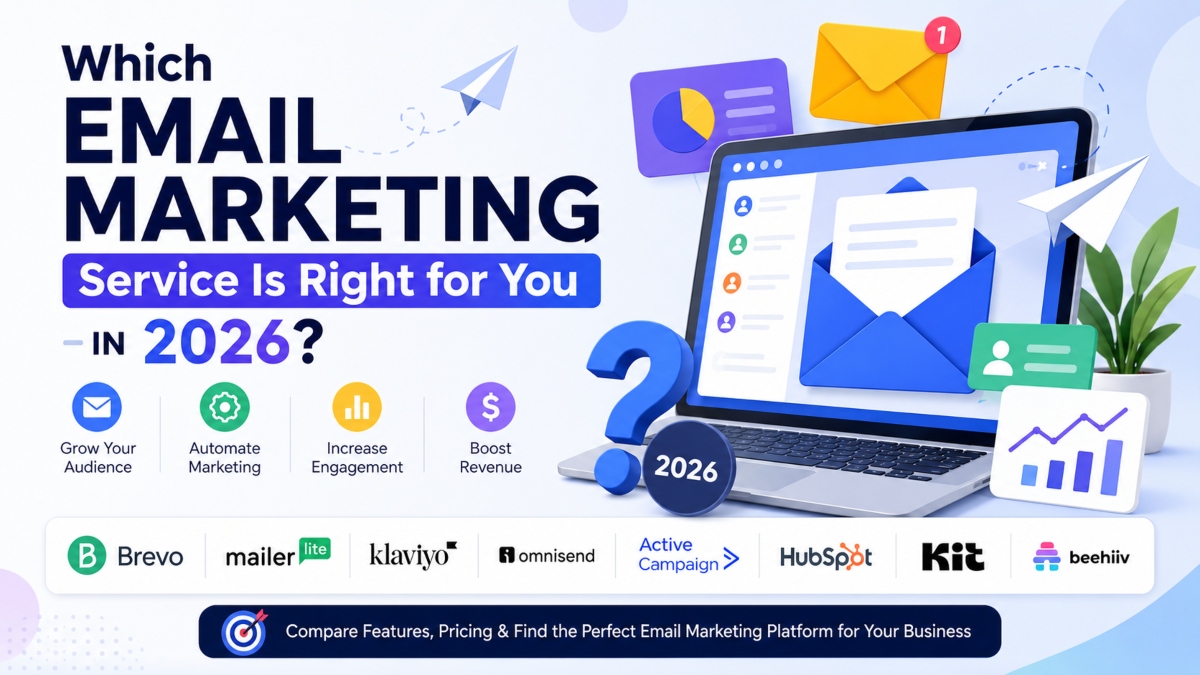
Finding the best email marketing service in 2026 is less about chasing the platform with the biggest feature list and more about choosing software that actually fits the way your business works. A small online store has very different needs from a creator running a paid newsletter or a B2B company managing long sales cycles. The right platform should save time, increase conversions, and make customer communication feel smooth instead of stressful.
Email marketing continues to deliver one of the strongest returns in digital marketing because it gives brands direct access to their audience without relying on changing social media algorithms. Businesses are also leaning harder into AI powered personalization, smarter segmentation, and automated customer journeys. At the same time, ecommerce brands are scaling faster, while the creator economy keeps pushing newsletters into mainstream media territory. That shift has made email marketing software far more advanced than it was just a few years ago.
For most businesses, Brevo stands out as the strongest all around option thanks to its balance of pricing, automation, SMS marketing, and transactional email features. MailerLite works well for beginners who want something clean and easy to learn without spending heavily upfront. Klaviyo remains the go to choice for ecommerce brands that rely on customer data and repeat purchases. ActiveCampaign fits companies that need deeper email automation tools and advanced workflows, while HubSpot makes sense for teams centered around CRM management and sales pipelines. For creators, Kit and Beehiiv continue to grow because they focus heavily on newsletters, audience growth, and monetization.
The best email marketing service 2026 readers choose will depend on one thing above all else: how well the platform matches their goals, workflow, and budget.
What Makes a Great Email Marketing Platform in 2026?
Choosing an email platform in 2026 is no longer just about sending newsletters. Modern businesses want smarter automation, cleaner analytics, stronger personalization, and tools that can grow alongside their audience. The best platforms make email marketing feel organized instead of overwhelming. They also help brands save time while driving more clicks, sales, and customer retention.
A proper email marketing tools comparison should focus on usability, automation strength, pricing flexibility, and email deliverability rather than flashy feature lists alone.
Ease of Use and Learning Curve
A good email marketing platform should feel intuitive from the first login. Clean dashboards, simple navigation, and drag and drop editors matter because they reduce setup time and help teams move faster. Beginners especially benefit from platforms that provide templates, guided onboarding, and straightforward campaign builders.
MailerLite has gained popularity for this exact reason. It strips away unnecessary clutter and keeps the experience smooth for freelancers, startups, and small business owners. Brevo also performs well here by balancing simplicity with more advanced marketing tools.
The reality is simple. If a platform feels confusing during the first week, most teams will never use its full potential.
Automation and AI Features
Automation now sits at the center of modern email strategy. Businesses want software that can send welcome sequences, abandoned cart reminders, lead nurturing emails, and customer follow ups without constant manual work.
The strongest marketing automation software also includes AI powered features such as subject line suggestions, send time optimization, audience segmentation, and predictive analytics. Klaviyo and ActiveCampaign stand out because they allow brands to build detailed customer journeys based on user behavior, purchases, clicks, and browsing activity.
Smart automation saves time, but it also creates more relevant experiences for subscribers. That usually translates into higher engagement and stronger revenue over time.
Pricing and Scalability
Pricing can look attractive at first until subscriber counts begin to grow. Many platforms offer free plans, but those plans often come with restrictions on automation, branding, or monthly sends.
Businesses should pay close attention to subscriber based pricing and upgrade thresholds. Some tools remain affordable for small lists but become expensive once a brand starts scaling. Brevo remains competitive because its pricing structure is more flexible than many traditional platforms.
Choosing software that can scale smoothly helps businesses avoid painful migrations later.
Deliverability and Analytics
Even the best designed campaign means nothing if emails never reach the inbox. Strong email deliverability has become one of the most important factors when choosing a platform in 2026.
Reliable providers invest heavily in sender reputation, spam prevention, and authentication tools. Businesses also need reporting dashboards that clearly track open rates, click through rates, conversions, and subscriber behavior.
A B testing features are equally valuable because they help marketers improve subject lines, layouts, and calls to action using real performance data instead of guesswork.
Best Email Marketing Services Compared for 2026
Brevo: Best Overall Value for Growing Businesses
Brevo has quietly turned itself into one of the smartest choices in the email marketing space. While many platforms push businesses toward expensive upgrades the moment subscriber counts increase, Brevo keeps things practical. It offers a strong mix of automation, email campaigns, SMS marketing, and transactional messaging without forcing small companies into enterprise level pricing.
That balance is exactly why so many growing brands now see it as the best overall value in 2026.
For small and medium sized businesses, cost matters just as much as features. Plenty of tools look impressive during demos but become painfully expensive once a list starts growing. Brevo avoids that trap with pricing that feels more manageable for startups, ecommerce shops, agencies, and local businesses trying to scale carefully.
One of the biggest advantages Brevo offers is its multichannel marketing setup. Instead of limiting communication to email alone, businesses can manage email campaigns, SMS messages, customer automations, and transactional notifications from one dashboard. That creates a smoother workflow for teams that want customer communication in one place instead of scattered across multiple apps.
For example, an ecommerce store can send promotional campaigns through email, follow up with SMS reminders during sales events, and automatically trigger order confirmations or shipping updates through its transactional email service. That kind of integration saves time while creating a more connected customer experience.
Automation is another area where Brevo performs surprisingly well for its price point. Users can build workflows based on customer actions, email engagement, purchases, or website behavior. Welcome sequences, abandoned cart reminders, lead nurturing campaigns, and re engagement emails are all possible without requiring advanced technical knowledge.
The interface also deserves credit because it avoids the clutter that makes some email platforms frustrating to use. Campaign setup feels straightforward, navigation stays clean, and automation builders remain approachable even for newer marketers. That simplicity makes Brevo especially attractive for businesses without dedicated marketing departments.
Another reason Brevo stands out is flexibility. Some email marketing tools focus heavily on one audience. Klaviyo leans toward ecommerce. HubSpot works best for CRM driven sales teams. Kit targets creators. Brevo sits comfortably in the middle, which makes it useful for a wider range of industries.
Small businesses often need software that can wear multiple hats. They may need newsletters, sales promotions, contact management, appointment reminders, and transactional emails all running at the same time. Brevo handles that mix better than many competitors in its price range.
Its transactional email capabilities also give it an edge over simpler newsletter platforms. Businesses can send password resets, purchase receipts, account notifications, booking confirmations, and automated alerts directly through the same ecosystem. That removes the need for separate transactional email tools, which helps reduce costs and technical complexity.
From a performance perspective, Brevo also delivers solid email deliverability rates. Messages generally land where they should, analytics remain easy to understand, and reporting tools provide enough insight for most growing companies. Open rates, click tracking, campaign performance, and audience behavior are all visible without forcing users into overly technical dashboards.
The platform may not have the deepest automation engine in the market. ActiveCampaign still offers more advanced workflow customization for businesses running highly detailed funnels. But for many SMBs, Brevo hits the sweet spot between functionality and usability.
There is also the question of scalability. Many businesses start with simple newsletter campaigns but eventually need more advanced marketing systems as their audience expands. Brevo makes that transition easier because companies can gradually add automation, SMS campaigns, and customer segmentation without switching platforms entirely.
For businesses focused on growth without overspending, that matters a lot.
Brevo works especially well for:
- Small and medium sized businesses
- Ecommerce stores with moderate automation needs
- Startups managing tight budgets
- Agencies handling multiple client campaigns
- Companies needing both marketing and transactional email service tools
- Teams looking for affordable email marketing software with room to scale
The biggest strength of Brevo is not flashy AI or enterprise complexity. It is practicality. The platform gives businesses enough power to grow while keeping costs and learning curves under control.
In a market crowded with bloated software and rising subscription fees, that approach feels refreshingly useful in 2026.
MailerLite: Best for Beginners and Simplicity
Some email marketing platforms feel like they were built for engineers instead of business owners. MailerLite succeeds because it takes the opposite approach. The platform keeps things clean, approachable, and easy to understand from the very first login. For beginners entering the world of email marketing in 2026, that simplicity can make a massive difference.
MailerLite has become one of the most trusted beginner email marketing tools because it removes the clutter that often overwhelms new users. The dashboard feels organized, navigation is straightforward, and the learning curve stays refreshingly low. Instead of spending days figuring out complicated settings, users can start building campaigns almost immediately.
That ease of setup makes MailerLite especially attractive for bloggers, freelancers, creators, coaches, and small business owners who may not have dedicated marketing teams. Many people simply want to build a newsletter, create signup forms, automate a few emails, and grow their audience without wrestling with technical complexity.
MailerLite handles those core tasks very well.
The drag and drop email editor is one of the platform’s strongest features. Users can quickly build professional looking newsletters without design experience or coding knowledge. Templates remain modern and flexible, while customization feels simple enough for first time users.
Another major reason MailerLite continues to grow is its generous free plan. Many free email marketing tools limit access to important features or make the platform feel restrictive unless users upgrade immediately. MailerLite gives smaller businesses enough room to test campaigns, build subscriber lists, and learn the basics before committing to a paid plan.
For startups and solo creators working with limited budgets, that matters a lot.
The platform also includes landing pages, signup forms, popups, and basic automation workflows inside the same system. That all in one setup helps users avoid stacking multiple tools together during the early stages of growth. Someone running a personal blog or small online business can realistically manage most of their email marketing needs directly from MailerLite without feeling boxed in.
Automation inside MailerLite is simpler than platforms like ActiveCampaign, but that is part of its appeal. The workflows remain easy to build and understand, making them ideal for welcome sequences, lead magnets, subscriber onboarding, and simple customer follow ups.
Instead of throwing endless customization options at users, MailerLite focuses on clarity and usability.
The platform also performs well when it comes to email deliverability and reporting. Users can track opens, clicks, subscriber growth, and campaign performance through analytics dashboards that stay clean and readable. The data feels practical instead of overly technical, which suits beginners perfectly.
For bloggers and freelancers, MailerLite hits a very comfortable middle ground. It offers enough features to support audience growth while avoiding the bloated experience that often comes with enterprise focused software. Writers can build newsletters, creators can launch email courses, and small businesses can run promotional campaigns without needing advanced technical skills.
That simplicity becomes one of its biggest strengths.
MailerLite may not have the deepest automation engine, advanced CRM integrations, or ecommerce intelligence found in platforms like Klaviyo or HubSpot. But not every business needs that level of complexity. Many users simply want software that works smoothly, looks modern, and helps them communicate consistently with their audience.
In that category, MailerLite remains one of the strongest choices available in 2026.
Klaviyo: Best for Ecommerce Stores
Klaviyo has built its reputation around one thing: helping online stores generate more revenue through smarter email marketing. While some platforms try to serve every type of business, Klaviyo stays heavily focused on ecommerce, and that focus is exactly why it performs so well in 2026.
For brands running Shopify or WooCommerce stores, Klaviyo feels less like a standard email platform and more like a sales engine connected directly to customer behavior. The software tracks browsing activity, purchase history, abandoned carts, product preferences, and engagement patterns in real time. That level of data gives ecommerce brands far more control over how they communicate with shoppers.
The platform’s ecommerce integrations are one of its biggest strengths. Connecting Klaviyo with Shopify, WooCommerce, BigCommerce, or Magento is usually straightforward, and once synced, the system starts pulling customer and store data automatically. Instead of manually building audience lists, businesses can create highly targeted segments based on shopping habits and purchase intent.
For example, a clothing store can automatically target customers who viewed jackets but never completed checkout. A beauty brand can recommend products related to previous purchases. A supplement company can trigger refill reminders based on estimated usage timelines.
That kind of personalization has become essential in modern ecommerce marketing.
Klaviyo also stands out because of its revenue tracking capabilities. Many email platforms show open rates and click rates, but ecommerce businesses care about one metric above all else: sales. Klaviyo connects campaign performance directly to revenue so brands can clearly see which emails generate purchases and which automations drive the highest return.
This creates a much stronger picture of marketing performance than basic engagement metrics alone.
Automation inside Klaviyo is built specifically for online stores. Businesses can create abandoned cart flows, post purchase sequences, win back campaigns, browse abandonment emails, VIP customer rewards, and product replenishment reminders with relatively little manual work.
The workflows are detailed without feeling impossible to manage. That balance makes Klaviyo attractive for both fast growing brands and larger ecommerce businesses handling high customer volumes.
One feature that continues to separate Klaviyo from simpler ecommerce email marketing software is predictive analytics. The platform uses customer data to estimate future purchasing behavior, customer lifetime value, and churn risk. That allows brands to build campaigns around likely behavior instead of reacting after sales drop.
In practical terms, businesses can identify high value customers earlier, create retention campaigns before buyers disappear, and target shoppers with offers that feel more relevant to their interests.
Product recommendation tools are another major advantage. Klaviyo can automatically insert personalized product suggestions into emails based on browsing history, purchase behavior, or customer preferences. That makes promotional campaigns feel more tailored instead of generic.
For ecommerce stores trying to increase repeat purchases, this feature alone can have a noticeable impact on conversion rates.
The platform also handles SMS marketing, which has become increasingly important for online retail brands. Businesses can coordinate email and text campaigns together, creating a smoother customer journey across multiple channels.
Of course, Klaviyo is not the cheapest option available. Pricing rises quickly as subscriber counts grow, especially for stores with large customer databases. Smaller businesses with simple newsletter needs may find platforms like MailerLite or Brevo more affordable during early growth stages.
There is also a learning curve compared to beginner focused tools. Because Klaviyo offers deeper segmentation, advanced automations, and detailed analytics, it takes more time to fully understand the platform’s capabilities.
But for serious ecommerce brands, the tradeoff usually feels worth it.
Klaviyo works best for:
- Shopify stores
- WooCommerce businesses
- Ecommerce brands focused on repeat purchases
- Online retailers using customer segmentation heavily
- Businesses wanting detailed revenue attribution
- Stores investing in automation and personalization
The platform succeeds because it understands ecommerce at a deeper level than most competitors. Instead of treating email marketing as simple broadcasting, Klaviyo treats it as customer driven revenue generation.
That mindset keeps it firmly near the top of the ecommerce email marketing software market in 2026.
ActiveCampaign: Best for Advanced Automation
ActiveCampaign is built for businesses that want far more than simple newsletters and scheduled campaigns. While beginner focused platforms concentrate on ease of use, ActiveCampaign leans heavily into automation depth, customer behavior tracking, and sales workflow management. For companies running detailed marketing funnels in 2026, it remains one of the strongest platforms available.
The biggest reason businesses choose ActiveCampaign is flexibility. The platform allows teams to build highly customized automations based on customer actions, engagement patterns, website activity, purchases, and lead behavior. Instead of sending the same message to every subscriber, companies can create dynamic experiences that adapt in real time.
That level of control makes ActiveCampaign especially powerful for SaaS companies, B2B businesses, agencies, and brands managing longer customer journeys.
The automation builder itself is one of the platform’s standout features. Workflows can become incredibly detailed without feeling completely unmanageable. Businesses can create onboarding sequences, lead nurturing campaigns, abandoned cart reminders, upsell flows, webinar funnels, and customer retention campaigns all inside the same system.
This is where ActiveCampaign separates itself from simpler email tools. It is designed for businesses that see email as part of a larger sales and relationship strategy rather than just a communication channel.
Lead scoring is another major advantage. The platform can automatically assign scores to contacts based on actions such as email opens, website visits, link clicks, purchases, or demo requests. That allows sales teams to identify high intent leads faster and focus attention where conversions are most likely.
For B2B companies especially, this creates a much stronger connection between marketing and sales.
CRM automation also plays a huge role in ActiveCampaign’s appeal. The built in CRM allows businesses to manage pipelines, track customer interactions, automate follow ups, and organize contacts without needing separate software for every task. Teams can move leads through sales stages automatically based on behavior and engagement.
For example, if a prospect downloads a guide, visits pricing pages several times, and clicks multiple emails, the system can automatically notify a sales representative or move that lead into a higher priority pipeline stage.
That kind of automation saves time while reducing missed opportunities.
Behavioral targeting is another area where ActiveCampaign performs extremely well. The platform tracks customer interactions across email campaigns, websites, and other touchpoints to create more personalized messaging. Businesses can send targeted offers, educational content, or sales messages based on actual user behavior rather than broad assumptions.
This makes customer journey automation feel far more natural and relevant.
A software company, for instance, can send different onboarding emails depending on which product features a user interacts with. An online course business can automatically recommend advanced lessons based on viewing history. Ecommerce brands can create re engagement campaigns triggered by inactivity or purchase patterns.
These experiences feel more personalized because they are driven by behavior instead of static subscriber lists.
Another strength of ActiveCampaign is integration support. The platform connects with ecommerce systems, CRM tools, webinar software, landing page builders, and hundreds of third party applications. Businesses running complicated marketing stacks can usually fit ActiveCampaign into their existing workflow without major disruption.
That said, the platform is not ideal for everyone.
The learning curve is noticeably steeper compared to tools like MailerLite or Brevo. New users may initially feel overwhelmed by the number of automation options, settings, and workflow possibilities. Businesses that only need basic newsletters or simple campaigns could end up paying for features they rarely use.
Pricing also increases as automation needs and subscriber counts grow. For smaller companies with limited budgets, that can become a consideration over time.
Still, for businesses focused heavily on sales funnel automation and advanced customer segmentation, ActiveCampaign remains one of the most capable platforms on the market.
It works especially well for:
- SaaS companies
- B2B businesses
- Agencies managing client funnels
- Brands using advanced lead nurturing
- Companies needing CRM and automation together
- Teams focused on behavioral targeting
ActiveCampaign succeeds because it treats automation like a complete customer relationship system rather than a collection of isolated email campaigns.
For businesses serious about customer journey automation in 2026, few platforms offer the same level of depth and control.
HubSpot: Best for CRM and Sales Teams
HubSpot approaches email marketing differently from most platforms. Instead of treating email as a standalone tool, it places email inside a much larger business ecosystem built around customer relationships, sales pipelines, and team collaboration. That strategy makes HubSpot one of the strongest choices for companies that rely heavily on CRM management and long term lead nurturing in 2026.
For businesses juggling marketing campaigns, sales conversations, customer support, and reporting across multiple departments, HubSpot offers a level of organization that many email tools simply cannot match.
At the center of the platform is its powerful email marketing CRM system. Every interaction stays connected to a single customer profile, allowing teams to track emails, calls, meetings, form submissions, website visits, and deal activity from one place. This gives businesses a much clearer picture of how leads move through the sales process.
For sales teams, that visibility becomes extremely valuable.
Instead of working with disconnected spreadsheets and scattered tools, HubSpot creates a shared environment where marketing and sales teams can operate together. A marketer can see when a lead opens emails or downloads content, while a sales representative can track conversations, update deal stages, and follow customer activity in real time.
That alignment helps businesses create smoother lead nurturing workflows and stronger communication across departments.
Automation inside HubSpot is also deeply connected to customer behavior and sales activity. Businesses can build workflows that trigger emails, assign tasks, update records, or notify team members automatically based on user actions.
For example, if a prospect downloads a pricing guide and revisits the website several times, the system can alert the sales team immediately. If a lead becomes inactive, HubSpot can launch re engagement campaigns without manual input.
This creates a more responsive customer experience while helping teams avoid missed opportunities.
Reporting tools are another major reason businesses invest in HubSpot. The platform provides detailed dashboards covering email performance, sales activity, conversion tracking, lead sources, pipeline growth, and customer engagement. Instead of pulling data from separate systems, businesses can monitor performance across the entire customer journey from one interface.
For companies making data driven decisions, this level of reporting can be incredibly useful.
Pipeline visibility is especially strong inside HubSpot. Sales managers can track deals through every stage of the funnel while monitoring team performance and forecasting revenue more accurately. That makes the platform attractive for B2B businesses, agencies, SaaS companies, and service based organizations managing complex sales cycles.
The collaborative side of HubSpot also deserves attention. Teams can leave notes, assign tasks, share contact records, and coordinate activities directly inside the platform. This reduces communication gaps and keeps everyone working from the same information.
For growing companies, that operational clarity can save significant time.
HubSpot also includes tools beyond email marketing. Landing pages, live chat, forms, ad tracking, customer service systems, and content management features are all available within the broader ecosystem. Businesses wanting a centralized marketing and sales platform often find this all in one structure appealing.
Of course, HubSpot is not the cheapest option on the market. Costs can increase quickly as businesses unlock more advanced features, automation capabilities, and larger contact databases. Smaller companies with basic newsletter needs may find platforms like MailerLite or Brevo more budget friendly.
There is also a level of complexity that comes with such a large ecosystem. Businesses willing to invest time into setup and training usually get far more value from the platform than teams looking for quick and lightweight email tools.
Still, for organizations focused heavily on CRM integration, sales management, and long term lead nurturing, HubSpot remains one of the most complete platforms available in 2026.
It works especially well for:
- B2B businesses
- SaaS companies
- Sales driven organizations
- Agencies managing multiple pipelines
- Teams needing advanced reporting
- Businesses wanting marketing and CRM tools together
HubSpot succeeds because it connects marketing, sales, and customer management into one unified system instead of forcing businesses to stitch together separate tools.
For companies that treat customer relationships as a long game, that structure makes a lot of sense.
Kit: Best for Creators and Personal Brands
Kit has carved out a very specific place in the email marketing world. While many platforms focus on ecommerce stores or corporate sales teams, Kit is built for people turning their audience into a business. Writers, YouTubers, podcasters, coaches, educators, and independent creators all need something slightly different from traditional email software. They need tools that help grow an audience, build relationships, and generate income without unnecessary complexity.
That creator first mindset is what makes Kit one of the strongest newsletter platforms for creators in 2026.
One of Kit’s biggest strengths is simplicity mixed with smart audience management. The platform avoids the bloated feeling that often comes with enterprise focused software while still offering enough automation and segmentation to support serious audience growth.
Its audience tagging system is especially powerful for creators managing different subscriber interests. Instead of forcing users into rigid email lists, Kit allows creators to organize subscribers through tags based on behavior, interests, purchases, or engagement.
For example, a fitness creator can tag subscribers interested in nutrition separately from those interested in workout plans. A business coach can segment readers based on webinars attended, products purchased, or content consumed.
This creates far more personalized communication without becoming difficult to manage.
Audience tagging also helps creators avoid one of the biggest mistakes in email marketing: sending the same message to everyone. Subscribers receive content that feels more relevant to their interests, which often leads to stronger engagement and higher conversions over time.
Automation inside Kit follows the same creator focused philosophy. The workflows are designed to support audience building, product launches, lead magnets, email courses, and subscriber onboarding rather than overly technical sales funnels.
A creator can automatically deliver free downloads, launch welcome sequences, promote digital products, or nurture subscribers into paid memberships with relatively little setup. The platform keeps these automations approachable instead of overwhelming users with endless configuration options.
Newsletter monetization is another area where Kit performs extremely well. Many creators are no longer using newsletters simply for communication. They are turning them into revenue generating businesses through subscriptions, sponsorships, digital products, affiliate offers, and online courses.
Kit supports this shift by making monetization tools feel naturally integrated into the platform. Creators can sell products, collect payments, build paid newsletters, and connect their email audience directly to income streams without relying heavily on outside systems.
That makes the platform especially attractive for independent creators building personal brands around expertise, entertainment, or niche communities.
The writing experience inside Kit also feels intentionally creator friendly. The email editor stays clean and distraction free, allowing writers to focus more on storytelling and communication instead of complicated design tools. This works particularly well for personality driven newsletters where strong writing matters more than flashy layouts.
Deliverability remains solid as well, which is critical for creators whose businesses depend heavily on audience trust and consistent inbox placement. Reliable delivery helps newsletters maintain engagement and protects revenue opportunities tied to sponsorships or product launches.
Kit may not offer the deep ecommerce intelligence of Klaviyo or the advanced CRM systems found in HubSpot, but that is not really its goal. The platform is designed around audience relationships rather than corporate sales infrastructure.
For creators, that distinction matters.
The platform works especially well for:
- Newsletter writers
- YouTubers and podcasters
- Coaches and consultants
- Digital product creators
- Personal brands
- Independent educators
- Paid newsletter businesses
Kit succeeds because it understands that creators need simplicity, flexibility, and monetization tools more than enterprise level complexity.
In 2026, where newsletters continue evolving into full scale media businesses, that focused approach gives Kit a strong advantage.
Beehiiv: Best for Newsletter Businesses
Beehiiv has quickly become one of the most talked about platforms in the newsletter world because it understands a major shift happening across digital media. Newsletters are no longer just marketing tools. For many creators and publishers, they are the business itself.
That distinction is exactly why Beehiiv stands out as one of the best newsletter platforms 2026 has to offer.
The platform is built specifically for growth driven newsletter brands that want to scale audiences, increase engagement, and create reliable revenue streams. While traditional email marketing software focuses heavily on promotions and sales funnels, Beehiiv approaches newsletters more like modern media products.
This makes it especially attractive for writers, independent publishers, niche media brands, analysts, and creators building audience first businesses.
One of Beehiiv’s strongest features is its referral program system. Audience growth is one of the hardest parts of running a newsletter, and Beehiiv turns subscribers into active promoters by rewarding referrals automatically.
For example, readers can unlock exclusive content, merchandise, private communities, or bonus resources after referring friends to the newsletter. This creates a built in growth loop that helps newsletters expand organically without depending entirely on paid advertising or social media algorithms.
That kind of audience driven growth has become incredibly valuable in 2026.
Beehiiv also separates itself through newsletter monetization features. Instead of forcing creators to piece together multiple external tools, the platform includes revenue focused systems directly inside the ecosystem.
Its ad network is one of the clearest examples. Beehiiv connects eligible newsletters with sponsorship opportunities, allowing creators to earn advertising revenue without manually chasing brand deals. For smaller or newer newsletter operators, this creates a much easier path toward monetization.
The platform also supports paid subscriptions, premium content, and audience segmentation for creators building subscription based businesses.
Growth focused tools are another major reason Beehiiv continues gaining momentum. The platform includes analytics, subscriber tracking, audience segmentation, recommendation systems, and optimization features designed specifically for scaling newsletters.
The recommendation network is particularly useful because it helps newsletters cross promote each other. Subscribers joining one publication can receive recommendations for similar newsletters, creating additional exposure opportunities for creators trying to grow quickly.
Beehiiv’s writing experience also feels polished and modern. The editor remains clean and easy to use while giving creators enough flexibility to maintain strong branding and professional presentation. This balance works well for publishers who care about both content quality and audience experience.
Another advantage is the platform’s focus on speed and usability. Setting up newsletters, creating signup pages, and launching campaigns feels relatively straightforward compared to some older email marketing systems that still carry outdated interfaces and complicated workflows.
For creators trying to move quickly, that simplicity matters.
Beehiiv may not offer the advanced automation depth found in ActiveCampaign or the ecommerce intelligence of Klaviyo, but it is not trying to compete in those categories. Its strength comes from understanding the economics of newsletter businesses and building tools specifically around audience growth and monetization.
That focused strategy makes the platform feel highly relevant in today’s creator economy.
Beehiiv works especially well for:
- Newsletter publishers
- Independent media brands
- Writers building subscription businesses
- Analysts and researchers
- Content creators growing audience based brands
- Creators seeking advertising revenue opportunities
The platform succeeds because it treats newsletters as scalable media businesses rather than simple email campaigns.
For creators serious about audience growth and newsletter monetization in 2026, Beehiiv has become one of the strongest platforms in the market.
Which Email Marketing Service Fits Your Business Type?
The best email marketing platform depends heavily on the kind of business you run. A creator building a paid newsletter needs very different tools from an ecommerce store managing thousands of products or a SaaS company handling long sales cycles. Choosing software based on your business model usually leads to better results than chasing the platform with the biggest feature list.
Here is where each platform fits best in 2026.
Best for Small Businesses on a Budget
For small businesses trying to control costs while still building professional email campaigns, Brevo and MailerLite remain the strongest choices.
Brevo works well for businesses that want more than just newsletters. It combines email marketing, SMS campaigns, automation, and transactional messaging inside one affordable platform. Small ecommerce shops, local businesses, startups, and agencies often benefit from this all in one setup because it reduces the need for multiple subscriptions.
MailerLite takes a simpler approach. Its clean dashboard, beginner friendly editor, and generous free plan make it ideal for freelancers, bloggers, coaches, and smaller brands that mainly need newsletters and basic automations. Businesses without technical experience usually adapt to MailerLite very quickly.
Best for Ecommerce Brands
Ecommerce businesses rely heavily on customer data, purchase behavior, and automation, which is why Klaviyo and Omnisend continue leading this category.
Klaviyo remains one of the strongest platforms for Shopify and WooCommerce stores because it connects deeply with ecommerce data. Brands can build personalized campaigns based on browsing history, abandoned carts, customer spending patterns, and repeat purchase behavior. Its revenue tracking and predictive analytics features also help businesses measure campaign performance more accurately.
Omnisend works well for online stores that want multichannel communication without excessive complexity. The platform combines email, SMS, and ecommerce focused automation in a way that feels approachable for growing brands.
Best for SaaS and B2B Companies
SaaS businesses and B2B companies often need detailed lead nurturing systems, customer journey tracking, and close alignment between sales and marketing teams. That is where ActiveCampaign and HubSpot stand out.
ActiveCampaign offers deep automation capabilities with behavioral targeting, lead scoring, and highly customizable workflows. Companies running long conversion funnels or advanced onboarding sequences often benefit from its flexibility.
HubSpot focuses more heavily on CRM integration and sales visibility. Businesses can manage contacts, pipelines, reporting, and email campaigns from one ecosystem. For larger teams handling complex customer relationships, that centralized structure becomes extremely useful.
Best for Creators and Media Brands
For creators building audience first businesses, Kit and Beehiiv remain two of the most relevant platforms available.
Kit is ideal for creators who want strong audience tagging, subscriber segmentation, and creator focused automations without unnecessary complexity. Coaches, YouTubers, writers, and digital product sellers often prefer its clean workflow and monetization features.
Beehiiv takes a more media driven approach. Its referral programs, ad network, and growth tools are built specifically for newsletter businesses trying to scale audiences and generate revenue through subscriptions or sponsorships.
Best for Nonprofits and Simple Campaigns
Nonprofits, community organizations, and businesses running simple campaigns often need affordability and ease of use more than advanced automation.
MailerLite works well because it keeps costs manageable while offering newsletters, landing pages, and basic automations inside a beginner friendly platform.
Constant Contact also remains a practical option for organizations focused on event updates, fundraising campaigns, volunteer communication, and simple email outreach. Its interface stays approachable for teams without dedicated marketing experience.
The key takeaway is simple. The best email platform for one business may be completely wrong for another. Matching software to your business type, audience size, and growth strategy will almost always produce better results than chasing trendy features alone.
Pricing Comparison of Popular Email Marketing Platforms
Pricing has become one of the biggest deciding factors when choosing email marketing software in 2026. Many platforms look affordable at first glance, but costs can rise quickly once subscriber lists grow or advanced automation features become necessary. A proper email marketing pricing comparison should look beyond entry level plans and focus on long term value, scalability, and feature access.
The cheapest platform is not always the smartest investment. The best value email marketing software is the one that gives businesses the right balance between cost, automation, usability, and growth potential.
Free Plans Compared
Free plans are often where businesses begin, especially startups, bloggers, freelancers, and small ecommerce stores testing email marketing for the first time. Platforms like MailerLite and Brevo remain popular because their free tiers offer enough functionality to launch real campaigns without immediate pressure to upgrade.
MailerLite provides a beginner friendly free plan with access to newsletters, signup forms, landing pages, and basic automation tools. It works particularly well for creators and smaller brands trying to build audiences from scratch.
Brevo also performs strongly in this category because it allows users to send campaigns while still accessing automation and transactional email features. This gives growing businesses more flexibility compared to platforms that heavily restrict free accounts.
However, businesses should pay attention to subscriber limits, monthly sending caps, and branding restrictions. Many free plans place platform logos inside emails or lock advanced automation behind paid upgrades. As lists grow, these restrictions become more noticeable.
Paid Plan Breakdown
Once businesses move beyond free plans, pricing structures begin to vary significantly between platforms. Some services charge based on subscriber count, while others increase costs according to email volume or feature access.
MailerLite and Brevo usually remain among the most affordable options for smaller businesses and moderate subscriber lists. Their starter plans offer good value without immediately pushing users toward expensive upgrades.
Klaviyo tends to become more expensive as ecommerce stores scale because pricing rises alongside customer data and advanced automation usage. For online retailers generating strong revenue through email campaigns, that cost often feels justified. Smaller stores, however, may find the platform expensive during early growth stages.
ActiveCampaign and HubSpot sit at the higher end of the market because they combine automation, CRM tools, reporting systems, and sales management inside broader ecosystems. Businesses needing advanced workflows and team collaboration may see strong value here, but simpler users could end up paying for features they rarely use.
Which Platform Gives the Best ROI?
Return on investment depends heavily on business type and marketing strategy. For small businesses and startups, Brevo often delivers the strongest balance between affordability and functionality. It combines email campaigns, SMS marketing, automation, and transactional messaging without excessive pricing pressure.
MailerLite offers excellent ROI for beginners, bloggers, and freelancers because it keeps costs low while remaining easy to use.
For ecommerce brands, Klaviyo frequently justifies its higher pricing through stronger revenue tracking, customer segmentation, and personalized product recommendations. Businesses generating repeat purchases often recover platform costs quickly through improved conversions.
Meanwhile, ActiveCampaign and HubSpot deliver the best results for companies relying heavily on lead nurturing, CRM management, and complex customer journeys.
The smartest approach is not chasing the cheapest software. It is choosing a platform where the feature set matches the actual needs of the business without paying for unnecessary complexity.
How to Choose the Right Email Marketing Service
Choosing an email marketing platform in 2026 can feel overwhelming because nearly every service promises automation, analytics, AI tools, and higher conversions. The smarter approach is to ignore the marketing hype and focus on one simple question: does the platform actually fit the way your business operates?
The right software should support your workflow, scale alongside your audience, and make communication easier instead of more complicated.
Choose Based on Your Business Model
Different businesses need very different email strategies.
Ecommerce brands usually benefit most from platforms like Klaviyo or Omnisend because they rely heavily on customer data, abandoned cart recovery, product recommendations, and purchase tracking. These businesses need automation tied directly to shopping behavior.
B2B companies and SaaS brands often require deeper lead nurturing systems, CRM integration, and sales pipeline visibility. ActiveCampaign and HubSpot perform strongly here because they connect marketing activity with long sales cycles and customer relationship management.
For creators, writers, and newsletter businesses, simplicity and monetization tools matter more than enterprise style dashboards. Platforms like Kit and Beehiiv focus heavily on audience growth, subscriber segmentation, and newsletter revenue generation.
Local businesses usually need something more practical and affordable. Brevo and MailerLite work well because they combine straightforward campaign tools with manageable pricing and beginner friendly interfaces.
Match Features to Your Workflow
The next step is understanding which features actually matter to your daily operations.
Businesses running advanced customer journeys should focus on automation capabilities. If your strategy depends on welcome sequences, abandoned cart emails, behavioral targeting, or lead nurturing, platforms with stronger automation systems will save time and improve results.
CRM integration is equally important for sales driven organizations. Teams managing leads, appointments, and long customer relationships often benefit from platforms that connect email campaigns with customer records and sales pipelines.
Transactional email also matters more than many businesses realize. Ecommerce stores, booking platforms, and SaaS companies frequently need automated receipts, account notifications, password resets, or shipping updates. Using a platform that handles both marketing and transactional communication can simplify operations significantly.
Think About Long Term Growth
Many businesses choose software based only on current needs and ignore future growth. That usually becomes expensive later.
A platform that works perfectly for five hundred subscribers may become frustrating at fifty thousand. Businesses should think about scaling costs, automation flexibility, team collaboration features, and how easily customer data can be exported if migration becomes necessary later.
It is also worth considering how multiple team members will use the platform as the company grows. Reporting access, shared workflows, and collaboration tools become more important over time.
Before committing to any platform, test the free plans whenever possible. Running a few campaigns, building automations, and exploring the dashboard often reveals far more than feature comparison pages ever will.
Final Verdict
There is no single email marketing platform that dominates every category in 2026. The best choice depends entirely on how your business operates, how advanced your marketing strategy is, and how much complexity you actually need.
For most businesses, Brevo delivers the strongest overall balance. It combines affordable pricing, automation, SMS marketing, and transactional messaging inside one platform without becoming overly complicated. Small and growing businesses that want flexibility without massive software costs will likely get the best overall value here.
MailerLite remains the best beginner option because it keeps email marketing simple. The clean interface, easy setup process, and generous free plan make it ideal for bloggers, freelancers, startups, and smaller brands that want professional campaigns without a steep learning curve.
For ecommerce businesses, Klaviyo continues to lead the market. Its deep Shopify and WooCommerce integrations, predictive analytics, revenue tracking, and personalized product recommendations make it one of the strongest platforms for driving repeat purchases and customer retention.
When it comes to advanced automation, ActiveCampaign still stands near the top. Businesses running detailed sales funnels, lead nurturing campaigns, and behavior driven customer journeys will appreciate the platform’s workflow flexibility and CRM automation capabilities.
The biggest takeaway is simple. The best email marketing software is not the platform with the most features. It is the one that fits your business model, audience size, workflow, and long term growth plans without creating unnecessary friction.
That is the real difference between software that merely sends emails and software that actually helps businesses grow.