

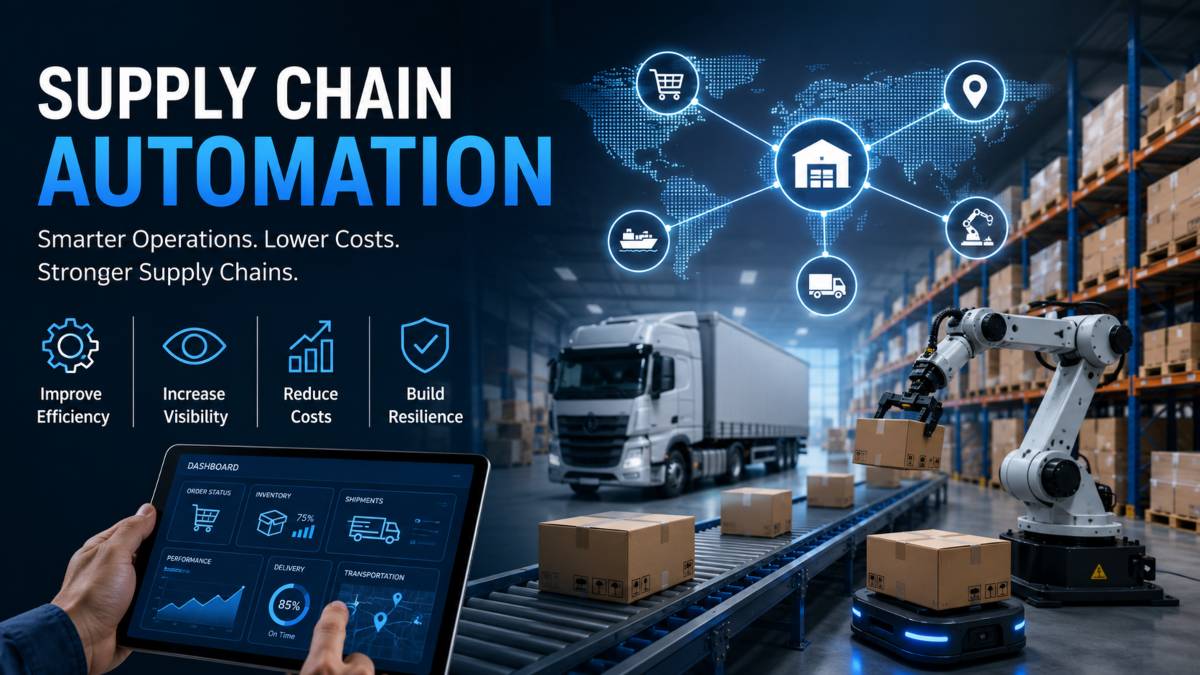
A single delayed shipment can trigger chaos across an entire operation. Orders pile up, customers start asking questions, warehouse teams scramble for missing inventory, and logistics costs quietly climb in the background. For many businesses, the real problem is not demand. It is the slow and outdated processes running behind the scenes. Manual data entry, disconnected systems, and spreadsheet driven workflows create friction at every stage of the supply chain.
This is where supply chain automation changes the game.
Companies are now using automation to move products faster, improve inventory management, and gain clearer visibility across procurement, warehousing, and transportation. Instead of relying on manual updates and reactive decisions, automated systems process information instantly and keep operations moving with fewer interruptions.
Modern logistics automation also helps businesses respond faster when demand shifts or unexpected delays appear. Real time tracking, automated inventory updates, and smarter forecasting tools allow teams to make quicker and more accurate decisions without wasting hours on repetitive tasks.
The result is stronger supply chain efficiency, lower operating costs, and a system built to scale without losing control. In a market where speed and accuracy shape customer trust, automation is quickly becoming a necessity rather than an option.
What Is Supply Chain Automation?
Supply chain automation refers to the use of technology to handle routine supply chain tasks with minimal human involvement. Instead of depending on spreadsheets, manual approvals, and constant data entry, businesses use digital systems to manage operations faster and with greater accuracy. The goal is simple. Reduce delays, improve visibility, and create a smoother flow from procurement to final delivery.
In a traditional setup, teams often spend hours updating inventory records, processing orders, tracking shipments, and fixing avoidable mistakes caused by manual input. These slow processes can create inventory gaps, missed deadlines, and rising operational costs. Automated supply chain systems replace much of that repetitive work with connected tools that process information in real time.
Several technologies power modern supply chain automation. Artificial intelligence helps companies improve forecasting and decision making using current and historical data. Machine learning systems identify patterns and improve operational accuracy over time. RFID technology and IoT sensors provide real time inventory tracking and shipment visibility across warehouses and transportation networks. Robotics supports faster picking, packing, and warehouse movement, while workflow software streamlines approvals, communication, and reporting between departments.
Common Processes Businesses Automate
Many companies begin their automation journey by focusing on repetitive tasks that consume time and create bottlenecks. Common examples include:
- order processing and fulfillment workflows
- inventory updates and stock monitoring
- shipment tracking and delivery notifications
- procurement and supplier coordination
- invoice handling and payment processing
By automating these areas, businesses improve supply chain efficiency while giving employees more time to focus on strategy, customer service, and operational growth.
Why Supply Chain Efficiency Matters
Supply chain efficiency has become a major factor in how businesses compete, grow, and retain customers. Consumers now expect faster deliveries, accurate tracking updates, and reliable service every time they place an order. At the same time, companies are dealing with rising transportation costs, labor shortages, and increasing pressure to keep operations running smoothly without inflating expenses.
This challenge becomes even more difficult during global disruptions. Weather events, supplier delays, fuel price increases, and unexpected demand spikes can quickly expose weak points in a supply chain. Businesses that rely on slow manual processes often struggle to respond fast enough when conditions change.
Efficient supply chain operations give companies the flexibility to adapt without losing momentum. Real time visibility into inventory, procurement, warehousing, and logistics performance allows teams to make smarter decisions before small issues become expensive problems. Strong operational efficiency also helps businesses improve customer satisfaction while protecting profit margins.
The Cost of Inefficient Supply Chains
Poor supply chain optimization can create serious operational and financial setbacks. Stockouts lead to missed sales and frustrated customers, while overstocking increases storage costs and ties up valuable capital. Delayed deliveries damage customer trust and weaken brand reputation in highly competitive markets.
Inefficient workflows also create labor waste, especially when employees spend hours correcting manual errors or chasing missing information. Forecasting mistakes can push businesses into buying too much inventory or failing to prepare for demand increases. Over time, these problems reduce agility, hurt logistics performance, and make growth harder to sustain.
How Automation Improves Supply Chain Efficiency
Supply chains move fast until manual processes slow everything down. A delayed inventory update, a missed shipment notification, or a forecasting mistake can ripple across procurement, warehousing, transportation, and customer service within hours. As operations grow more complex, businesses need systems that can react faster than spreadsheets and email chains ever could.
This is why supply chain automation has become a practical business tool rather than a luxury upgrade. Automation helps companies reduce repetitive work, improve accuracy, and create smoother operations across the entire supply chain.
Faster Order Processing and Operations
Manual workflows often create unnecessary delays. Employees spend time entering data, approving requests, updating spreadsheets, and transferring information between disconnected systems. These small tasks may seem harmless individually, but together they slow fulfillment and increase operational friction.
Automation speeds up these processes by allowing systems to handle routine actions instantly.
For example, an automated order management system can:
- receive customer orders in real time
- verify inventory availability
- trigger warehouse picking requests
- generate invoices automatically
- update shipping information without manual input
This creates a faster workflow from purchase to delivery. Teams spend less time handling repetitive administrative work and more time solving operational problems that actually require human judgment.
Businesses also gain stronger consistency because automated workflows follow the same rules every time. That reduces confusion, delays, and communication gaps between departments.
Better Inventory Management
Inventory problems are one of the biggest threats to supply chain efficiency. Running out of stock can damage customer trust, while excess inventory increases storage costs and waste. Many companies still struggle because their inventory systems rely on delayed updates or manual tracking methods.
Automated inventory management improves accuracy by tracking stock levels in real time.
When inventory changes, the system updates immediately across warehouses, sales platforms, and procurement tools. This gives managers a clearer picture of available stock without waiting for manual reports.
Automation also supports smarter replenishment. Instead of relying on guesswork, systems can trigger automatic restocking when inventory reaches a specific threshold.
Practical benefits include:
- fewer stockouts
- reduced overstocking
- improved warehouse organization
- faster inventory audits
- lower carrying costs
RFID technology and IoT sensors strengthen this process even further by monitoring product movement throughout the supply chain. Businesses gain stronger visibility into where products are located and how quickly inventory is moving.
More Accurate Demand Forecasting
Forecasting errors create expensive problems. If demand is underestimated, businesses may struggle with shortages and delayed deliveries. If demand is overestimated, warehouses fill with excess inventory that may never sell.
Automation improves forecasting by analyzing both historical and real time data.
Artificial intelligence and machine learning systems can identify patterns that humans often miss. These tools evaluate seasonal trends, customer purchasing behavior, market changes, and operational data to generate more accurate forecasts.
This allows businesses to:
- purchase inventory more strategically
- improve production planning
- reduce waste
- prepare for demand spikes earlier
- avoid unnecessary emergency shipments
For example, a retailer using automated forecasting software can identify rising demand for a product weeks before manual analysis would detect the trend. That early visibility helps the company adjust inventory levels before shortages occur.
Better forecasting creates stronger operational stability across the entire supply chain.
Improved Supply Chain Visibility
One of the biggest operational challenges is the lack of real time visibility. When systems are disconnected, managers often struggle to identify where delays are happening or which shipments are at risk.
Automation helps connect supply chain data into a single operational view.
With automated tracking systems, businesses can monitor:
- shipment locations
- warehouse activity
- supplier performance
- inventory movement
- transportation delays
This visibility allows companies to respond faster when disruptions occur.
For example, if weather conditions delay a shipment, automated logistics software can immediately notify managers and update estimated delivery times. Teams can then reroute shipments, communicate with customers, or adjust warehouse schedules before the disruption spreads further.
Real time visibility also improves collaboration between departments because everyone works from the same data instead of relying on outdated reports.
Lower Operational Costs
Rising logistics costs continue to pressure businesses across every industry. Labor expenses, fuel prices, storage fees, and operational inefficiencies can quickly reduce profit margins.
Automation helps control costs by reducing manual labor and minimizing expensive mistakes.
Tasks that once required large teams can now be completed faster through automated systems. Warehouse automation, for instance, allows robotic systems and scanning tools to handle repetitive movement and tracking tasks with greater speed and consistency.
Automation also reduces errors that lead to unnecessary expenses, including:
- incorrect shipments
- duplicate orders
- inventory mismatches
- missed invoices
- routing inefficiencies
Route optimization software helps logistics teams choose more efficient delivery paths, which lowers transportation costs and improves fuel efficiency.
Over time, these operational improvements create significant savings while allowing businesses to scale more smoothly.
Stronger Customer Satisfaction
Customers may never see the technology behind a supply chain, but they notice the results immediately. Faster deliveries, accurate orders, and reliable updates shape the overall customer experience.
Automation helps businesses meet those expectations consistently.
When supply chain systems work together, customers receive:
- quicker order processing
- accurate delivery estimates
- real time shipment tracking
- fewer fulfillment mistakes
- faster issue resolution
This level of reliability builds trust and encourages repeat business.
For example, automated tracking systems can send customers instant notifications about shipping progress, delays, or completed deliveries. That transparency reduces frustration and gives customers greater confidence in the buying process.
In highly competitive industries, strong supply chain efficiency often becomes a direct advantage. Businesses that deliver faster, communicate clearly, and avoid operational mistakes are more likely to retain customers over the long term.
Automation does not replace supply chain teams. It removes friction that slows them down. By improving speed, accuracy, visibility, and scalability, automation allows businesses to operate with greater control while preparing for future growth.
Faster Order Processing and Operations
Slow order processing can quietly damage an entire supply chain. When teams rely on manual approvals, spreadsheets, and repetitive data entry, even simple tasks take longer than they should. Orders get stuck between departments, fulfillment slows down, and customers are left waiting for updates.
Automated order processing removes much of this friction by allowing systems to handle routine tasks instantly and with greater accuracy. Instead of manually reviewing every order, automation tools can verify inventory, process purchase requests, generate invoices, and trigger shipment updates in real time.
This creates smoother workflows across procurement, warehousing, and logistics operations.
Workflow automation also helps businesses reduce approval delays. Orders move through the system faster because information is shared automatically between departments without constant back and forth communication. Teams no longer need to spend hours updating records or chasing missing details.
The impact becomes even more noticeable during high order volumes. Automated systems can process large numbers of transactions without slowing operations or increasing administrative pressure on employees.
Key benefits of faster fulfillment include:
- reduced order processing time
- fewer manual errors
- quicker approvals and inventory updates
- improved coordination between departments
- faster shipping and delivery timelines
For example, an ecommerce business using automated order processing software can instantly route incoming orders to the correct warehouse, update inventory levels, and send tracking information to customers without manual involvement. What once required multiple employees and several hours can now happen within minutes.
As supply chains grow more complex, businesses need operational speed that manual workflows simply cannot match. Automation helps companies move orders faster while maintaining stronger accuracy and consistency across the entire fulfillment process.
Better Inventory Management
Inventory problems rarely stay isolated for long. A single stock miscalculation can lead to delayed shipments, frustrated customers, excess storage costs, and missed revenue opportunities. When businesses rely on manual inventory tracking, updates are often delayed, inaccurate, or spread across disconnected systems. That lack of visibility creates constant uncertainty across the supply chain.
Inventory automation helps businesses replace guesswork with real time accuracy.
With automated inventory management systems, stock levels update instantly whenever products are sold, moved, returned, or restocked. Teams no longer need to manually count inventory or wait for spreadsheet updates to understand what is available across warehouses and distribution centers.
Real time inventory tracking also gives businesses stronger control over purchasing and fulfillment decisions. Managers can monitor inventory movement as it happens and react quickly before shortages or excess stock become larger operational problems.
One of the biggest advantages of automation is automatic replenishment. Instead of manually placing orders when stock appears low, automated systems can trigger replenishment requests based on predefined inventory thresholds, sales patterns, or demand forecasts. This keeps products moving without unnecessary delays or overordering.
Key benefits of automated inventory management include:
- fewer stockouts and missed sales
- reduced overstocking and storage expenses
- improved inventory accuracy
- faster warehouse operations
- stronger forecasting and purchasing decisions
For example, a retail company using inventory automation can automatically sync stock levels between online stores, warehouses, and suppliers in real time. If inventory drops below a certain level, the system immediately generates a replenishment order before shortages affect customers.
Technologies like RFID tracking and IoT sensors strengthen visibility even further by monitoring product movement throughout the supply chain. Businesses gain faster access to inventory data, which helps improve planning, fulfillment speed, and overall supply chain efficiency.
As customer demand becomes less predictable, companies need inventory systems that can adapt instantly. Automation gives businesses the visibility and control needed to manage inventory with greater speed, accuracy, and confidence.
More Accurate Demand Forecasting
Forecasting demand has always been one of the toughest parts of supply chain management. When businesses misread demand patterns, the consequences show up quickly. Too little inventory leads to shortages and delayed deliveries, while too much inventory increases storage costs and ties up cash in unsold products.
Traditional forecasting methods often rely on outdated spreadsheets, manual estimates, or limited historical data. That approach struggles to keep pace with changing customer behavior, seasonal shifts, and market disruptions.
Demand forecasting automation gives businesses a faster and more accurate way to plan ahead.
Using AI in supply chain management, automated systems can analyze large volumes of historical and live data in real time. These tools identify patterns, purchasing trends, seasonal demand changes, and operational risks that are difficult to detect manually.
Predictive analytics also allows businesses to react earlier when demand starts shifting. Instead of waiting for shortages or excess inventory to appear, companies can make proactive adjustments before problems affect operations.
This creates stronger purchasing and production planning across the supply chain.
For example, an automated forecasting system can detect rising product demand based on recent sales activity, customer behavior, supplier trends, and regional market conditions. The business can then increase purchasing volumes or adjust production schedules before inventory runs low.
Key benefits of demand forecasting automation include:
- improved inventory planning
- reduced stock shortages
- lower excess inventory costs
- better supplier coordination
- stronger production scheduling
- faster response to market changes
AI driven forecasting also improves long term decision making. Businesses gain clearer visibility into future demand patterns, which helps procurement, warehousing, logistics, and sales teams stay aligned.
As supply chains become more data driven, companies that rely on predictive analytics can make faster and smarter operational decisions with less uncertainty. Accurate forecasting not only improves efficiency but also helps businesses stay prepared when demand changes unexpectedly.
Improved Supply Chain Visibility
One of the biggest challenges in supply chain management is not knowing where problems are developing until they start affecting customers. A delayed shipment, missing inventory update, or warehouse bottleneck can spread across operations quickly when teams lack real time information.
Supply chain visibility helps businesses stay ahead of these disruptions instead of reacting after damage is already done.
Automation improves logistics visibility by connecting systems across procurement, warehousing, transportation, and fulfillment. Rather than relying on disconnected reports or manual updates, businesses gain access to live operational data from a single connected system.
Shipment tracking systems play a major role in this process. Companies can monitor product movement in real time, track delivery progress, and receive instant alerts when delays or disruptions appear. This allows teams to respond faster and make informed operational decisions before small issues turn into expensive setbacks.
For example, if a shipment is delayed due to weather conditions or transportation issues, automated systems can immediately notify managers, adjust estimated delivery times, and update customers automatically. Warehouse teams can also prepare for schedule changes earlier, which reduces confusion and operational slowdowns.
Improved supply chain visibility also strengthens coordination between departments. Procurement teams, warehouse managers, logistics providers, and customer service staff can all work from the same real time data instead of relying on outdated spreadsheets or fragmented communication.
Key benefits of stronger logistics visibility include:
- real time shipment tracking
- faster issue detection and response
- improved delivery accuracy
- stronger communication across operations
- fewer unexpected disruptions
- better customer updates and transparency
Automation also gives businesses deeper insight into performance trends. Managers can identify recurring delays, supplier issues, warehouse inefficiencies, and transportation bottlenecks using real time operational data.
As supply chains become larger and more complex, visibility becomes a major competitive advantage. Businesses that can track operations clearly and respond quickly are better prepared to maintain efficiency, reduce disruptions, and deliver a stronger customer experience.
Lower Operational Costs
Rising operational costs continue to pressure supply chains across every industry. Labor expenses, warehouse overhead, transportation fees, and fulfillment errors can quickly reduce profitability when processes are slow or inefficient. Many businesses lose money not because demand is weak, but because daily operations contain too much waste, duplication, and manual work.
Automation helps companies control these expenses by improving speed, accuracy, and operational consistency.
One of the biggest advantages is reduced labor costs. Employees no longer need to spend hours handling repetitive administrative tasks such as data entry, inventory updates, invoice processing, or manual shipment tracking. Automated systems complete these tasks faster and with fewer interruptions, allowing teams to focus on higher value operational work.
Automation also reduces expensive mistakes that often drain supply chain budgets. Incorrect orders, inventory mismatches, delayed shipments, and manual processing errors can create unnecessary costs across warehousing and logistics operations. Automated workflows help minimize these issues by improving accuracy at every stage of fulfillment.
Warehouse efficiency improves significantly when automation tools handle repetitive movement and tracking tasks. Barcode scanning systems, robotic picking technology, and automated inventory updates help warehouses process products faster while reducing delays and operational bottlenecks.
Logistics optimization also plays a major role in supply chain cost reduction. Automated route planning software helps transportation teams choose faster and more fuel efficient delivery paths. This lowers fuel consumption, reduces delivery delays, and improves fleet productivity.
Key benefits of automation for cost control include:
- lower administrative labor costs
- fewer fulfillment and inventory errors
- improved warehouse efficiency
- better transportation planning
- reduced fuel and storage expenses
- stronger use of operational resources
For example, a distribution company using automated route optimization software can reduce delivery times while cutting fuel usage across multiple transportation routes. At the same time, warehouse automation systems can process higher order volumes without requiring major increases in staffing.
Over time, these operational improvements create a leaner and more scalable supply chain. Businesses gain stronger control over spending while improving productivity, fulfillment speed, and overall logistics performance.
Stronger Customer Satisfaction
Customers expect more from supply chains than ever before. Fast shipping, accurate orders, and clear delivery updates are no longer considered extra benefits. They are part of the standard customer experience. When deliveries arrive late or orders contain mistakes, trust disappears quickly and customers often move to competitors.
Automation helps businesses meet these expectations with greater consistency and speed.
One of the biggest improvements comes from faster delivery performance. Automated workflows reduce delays across order processing, inventory handling, warehousing, and shipping operations. Orders move through the supply chain more efficiently because systems can process information instantly without waiting for manual approvals or updates.
Fulfillment accuracy also improves when automation reduces human error. Automated inventory systems, barcode scanning tools, and digital order verification help businesses ship the correct products to the right customers with fewer mistakes. This lowers return rates and reduces customer frustration caused by incorrect or incomplete orders.
Reliable tracking updates are another major advantage. Customers want visibility after placing an order, especially during shipping delays or high demand periods. Automated shipment tracking systems provide real time notifications about order status, shipping progress, and estimated delivery times. This creates a more transparent and dependable buying experience.
Key benefits for customer experience in logistics include:
- faster order fulfillment
- improved delivery performance
- higher fulfillment accuracy
- real time shipment visibility
- fewer delivery errors and delays
- stronger customer trust and retention
For example, an ecommerce company using automated logistics systems can instantly send tracking updates after an order ships while also notifying customers about delivery changes in real time. This level of communication helps reduce uncertainty and improves overall satisfaction.
Automation does more than improve internal operations. It directly shapes how customers experience a brand. Businesses that deliver quickly, communicate clearly, and maintain accurate fulfillment are more likely to build loyalty in highly competitive markets.
Examples of Supply Chain Automation in Action
Automation is no longer limited to large enterprise operations with massive budgets. Businesses across retail, manufacturing, ecommerce, healthcare, and logistics are using automation tools to improve speed, reduce operational pressure, and gain better control over supply chain performance. The biggest advantage is that automation solves practical day to day problems that slow operations and increase costs.
Warehouse Automation
Modern warehouses rely heavily on automation to handle growing order volumes without sacrificing speed or accuracy. Robotic pickers can move products through fulfillment centers faster than manual teams while reducing repetitive physical work. Automated storage systems also help warehouses organize inventory more efficiently by placing products in optimized locations for quicker retrieval.
Barcode scanning technology strengthens warehouse accuracy by updating inventory data instantly as products move through receiving, storage, packing, and shipping stages. This reduces manual inventory mistakes and gives warehouse managers better visibility into stock movement.
For example, an ecommerce warehouse using robotic picking systems and barcode scanning can process hundreds of customer orders in significantly less time while reducing fulfillment errors during peak shopping periods.
Logistics Automation
Transportation and delivery operations become far more efficient when automation handles tracking and route planning. GPS tracking systems allow logistics teams to monitor shipments in real time while giving customers accurate delivery updates throughout the shipping process.
Route optimization software helps drivers avoid traffic congestion, reduce fuel consumption, and improve delivery speed by selecting more efficient transportation routes. Automated delivery alerts also keep customers informed about shipment status without requiring manual communication from support teams.
For example, a delivery company using logistics automation can reroute drivers instantly during traffic delays while automatically updating customers about revised delivery times.
Back Office Automation
Administrative tasks often create hidden delays across supply chain operations. Manual invoice processing, purchase approvals, and procurement paperwork consume valuable time while increasing the risk of human error.
Back office automation streamlines these workflows by processing invoices digitally, routing purchase orders automatically, and improving communication between procurement teams and suppliers. This reduces approval delays and helps businesses maintain smoother operational flow.
For example, a manufacturing company can automatically generate purchase orders when inventory levels drop below a set threshold, eliminating the need for manual purchasing requests.
Smart Inventory Systems
Smart inventory systems improve supply chain visibility by tracking products in real time across warehouses, retail locations, and distribution centers. RFID tracking technology allows businesses to monitor inventory movement instantly without relying on manual stock checks.
Automatic replenishment systems help businesses avoid shortages by triggering restocking orders when inventory reaches predefined levels. Inventory syncing also ensures that stock data remains updated across ecommerce platforms, warehouses, and supplier systems simultaneously.
For example, a retailer using RFID tracking and automated inventory syncing can maintain accurate stock visibility across both online and physical store locations, reducing overselling and inventory confusion.
These practical automation tools help businesses operate with greater speed, accuracy, and efficiency while improving the customer experience across the entire supply chain.
Challenges of Supply Chain Automation
While automation offers major operational benefits, the transition is not always simple. Many businesses face technical, financial, and organizational challenges when introducing new systems into existing supply chain operations. Without proper planning, automation implementation can create short term disruption before long term improvements become visible.
One of the biggest concerns is upfront investment. Automation software, warehouse technology, tracking systems, and infrastructure upgrades often require significant financial commitment. Smaller businesses may hesitate to adopt automation because of budget limitations or uncertainty about return on investment.
Employee training is another common obstacle. Teams that have relied on manual processes for years may struggle to adapt to new technologies and workflows. Resistance to change can slow supply chain technology adoption if employees are not properly supported during the transition.
Software integration also creates challenges for many organizations. Older systems may not connect easily with modern automation platforms, which can lead to data gaps, workflow interruptions, and communication problems between departments.
Cybersecurity concerns continue to grow as supply chains become more connected through cloud systems, IoT devices, and digital platforms. Businesses handling large amounts of operational and customer data must protect systems from breaches, ransomware attacks, and unauthorized access.
Data quality issues can also weaken automation performance. Automated systems rely on accurate and consistent data to function properly. Poor inventory records, incomplete supplier information, or outdated operational data can reduce efficiency instead of improving it.
How Businesses Can Overcome Them
Successful digital supply chain transformation usually starts with a phased implementation strategy. Instead of automating every process at once, businesses can begin with high impact areas such as inventory tracking, order processing, or logistics management. This reduces operational pressure while allowing teams to adjust gradually.
Staff onboarding also plays a major role in successful automation implementation. Employees need proper training, clear communication, and ongoing support to build confidence in new systems and workflows.
Choosing scalable platforms is equally important. Businesses should invest in technology that can grow alongside operational needs without requiring constant replacement or expensive upgrades.
Regular process audits help companies identify inefficiencies, data problems, and integration gaps before automation systems are expanded further. By combining strong planning with practical implementation steps, businesses can improve supply chain technology adoption while reducing operational risk.
Best Practices for Implementing Supply Chain Automation
Successful supply chain automation is not only about installing new technology. It requires clear planning, realistic goals, and systems that support long term operational growth. Businesses that rush automation without preparation often face workflow disruptions, employee resistance, and poor performance results. A structured approach helps companies improve efficiency while reducing implementation risks.
Start With Repetitive Processes
The best starting point for automation is repetitive and time consuming tasks. Processes such as order entry, invoice handling, inventory updates, and shipment tracking consume valuable employee hours while creating opportunities for human error.
Automating these routine activities delivers quick operational improvements without creating major disruption across the supply chain. It also allows businesses to test automation systems gradually before expanding into more advanced areas.
For example, a company may begin by automating purchase order approvals and inventory updates before introducing warehouse robotics or predictive analytics tools.
Use Real Time Data
Automation systems perform best when they operate with accurate and current information. Real time data helps businesses respond faster to inventory changes, shipment delays, supplier issues, and customer demand shifts.
Connected inventory systems, live shipment tracking, and automated reporting tools give managers stronger visibility into daily operations. This improves decision making while reducing delays caused by outdated information.
Businesses that rely on real time operational data can also forecast demand more accurately and react faster when disruptions occur.
Connect Systems Across Departments
Supply chain automation becomes far more effective when departments work from connected systems instead of isolated platforms. Procurement, warehousing, logistics, sales, and customer service teams should have access to synchronized operational data.
Disconnected systems often create communication gaps, duplicate work, and inconsistent reporting. Integrated automation platforms improve coordination by allowing information to move automatically across departments in real time.
For example, when inventory levels change in a warehouse, procurement and sales teams can instantly view updated stock availability without manual communication.
Measure Performance With KPIs
Businesses should track clear performance indicators to measure the success of automation efforts. Without measurable goals, it becomes difficult to identify operational improvements or areas that still require adjustment.
Common supply chain KPIs include:
- order cycle time
- inventory turnover
- fulfillment accuracy
- transportation costs
Monitoring these metrics helps businesses understand how automation affects speed, operational efficiency, accuracy, and cost control over time.
Automation works best when businesses treat it as an ongoing operational strategy rather than a one time technology upgrade. Continuous monitoring, system improvements, and employee support help companies build more efficient and scalable supply chain operations.
The Future of Automated Supply Chains
Supply chains are moving toward a future shaped by faster data, smarter systems, and stronger operational intelligence. Businesses are no longer focused only on automating repetitive tasks. The next stage of automation is about creating supply chains that can predict problems, respond instantly, and make better decisions with minimal manual involvement.
AI powered supply chains are already changing how companies manage inventory, transportation, forecasting, and fulfillment. Artificial intelligence can analyze massive amounts of operational data in real time, helping businesses identify risks, forecast demand changes, and improve planning accuracy before disruptions affect performance.
Autonomous warehouses are also becoming more common. Robotics systems can handle picking, packing, sorting, and inventory movement with greater speed and consistency than traditional manual operations. These technologies help warehouses process higher order volumes while reducing delays and labor pressure.
Predictive logistics is another major shift shaping the future of logistics automation. Instead of reacting to transportation delays after they happen, automated systems can predict disruptions using traffic conditions, weather patterns, shipment data, and delivery performance trends. This allows businesses to reroute shipments earlier and maintain smoother operations.
Blockchain tracking is expected to strengthen supply chain transparency as well. Connected blockchain systems can create secure and traceable records for shipments, supplier activity, and inventory movement across global supply networks.
Smarter demand planning will continue improving through real time analytics, machine learning, and connected operational data. Businesses will gain stronger visibility into customer behavior and market trends, allowing them to adjust purchasing and production decisions with greater precision.
As smart supply chain technology continues evolving, companies that invest early in automation will be better prepared to handle rising customer expectations, operational complexity, and future market disruptions.
Final Thoughts
Supply chain automation is no longer limited to large corporations with massive logistics networks. Businesses of every size are using automation to improve speed, reduce operational waste, strengthen visibility, and create more reliable supply chain performance. As customer expectations continue rising and supply chains become more complex, manual processes simply cannot keep pace with modern operational demands.
Automation allows companies to process orders faster, manage inventory more accurately, reduce costly errors, and respond quickly when disruptions appear. It also gives teams access to real time data that supports smarter planning and better decision making across procurement, warehousing, and logistics operations.
The long term value goes beyond efficiency alone. Businesses that invest in automation build supply chains that are more scalable, agile, and prepared for future market changes.
Companies that wait too long to modernize often struggle with rising costs, slower fulfillment, and weaker operational control. Those that move early gain a stronger competitive position while creating a better customer experience.
Request a demo, talk to a supply chain expert, or download an automation checklist to identify the best opportunities for improving your supply chain operations today.